Employee Survey Is Not Telling You What You Need to Know
Why organisations that are serious about people performance, organisational culture, and change management need to go further than a satisfaction score and what a behavioural assessment built on 380 patterns and 20 levers actually reveals.
Picture a room full of senior leaders. They have just received the results of this year’s employee survey. Engagement is up three points. Satisfaction with leadership is at sixty-eight percent. The HR director presents the numbers with quiet pride.
Six months later, the operational excellence programme that was meant to transform the shopfloor has quietly stalled. The new CRM that was supposed to fix the sales process is being used at twenty percent of its capacity. The supply chain redesign is on hold because, as someone eventually admits in a review meeting, “people just are not on board.”
Feeling good about work and being ready to change how you work are two entirely different things. Most employee surveys measure only the first

The Employee Survey Was Built for a Different Problem
The employee survey has a clear and honourable origin. It was designed to help organisations understand whether people felt respected, heard, and motivated at work. Built on the logic that satisfied workers are more productive workers, it became the standard instrument of people measurement over decades.
That logic was never wrong. A workforce that feels valued is more stable, more creative, and more loyal. Employee satisfaction is a legitimate thing to monitor and improve.
The problem is not the survey itself. The problem is what we started asking it to do.
Somewhere along the way, organisations began using the employee survey as a proxy for organisational readiness. As a signal of change capacity. As evidence that the culture is healthy enough to absorb transformation. And it cannot carry that weight. It was never designed to.
What the Employee Survey Actually Measures
A typical employee survey asks people how they feel about their manager, their career, their workload, the company direction, and whether they would recommend the organisation as a place to work. It captures sentiment at a point in time. It reflects accumulated feelings about accumulated experiences.
This is useful data. But it is retrospective, individual, and surface-level. It tells you how people felt last month. It does not tell you how the organisation will behave next quarter when it is asked to do something genuinely difficult.
What Employee Survey Cannot Measure
Here is what most employee survey is designed to capture.
Whether people across functions genuinely share the same understanding of priorities, or simply know the language the organisation uses to describe them.
Whether middle management has the conviction to carry a change agenda forward, or is managing upward while quietly doing nothing differently.
Whether the resistance that will kill the next initiative is already present, already organised, and already invisible in the numbers.
Whether the organisation’s leadership team is seeing an accurate picture of its own culture, or a version that has been softened at every level before it arrived on their desk.
Whether the people running your operational improvements genuinely believe they will hold, or are executing them because they were told to.
These are the variables that determine whether a transformation succeeds. And every single one of them is invisible to the conventional employee survey.

The Five Ways Misalignment Hides in Plain Sight
Misalignment does not announce itself. It does not appear on dashboards. It does not surface in the executive summary of an employee survey report. It lives in the space between what leadership believes is happening and what is actually being experienced across the organisation.
There are five specific patterns through which misalignment compounds, silently and expensively, in most organisations.
The organisation your leadership team believes it is running and the organisation that actually exists are often meaningfully different. That gap is not a leadership failure. It is a measurement failure.
Pattern One: The Truth Gets Softened on the Way Up
Every layer of hierarchy edits the information that passes through it. Not through malice, but through rational self-interest. People learn, quickly, that reassuring news travels better than troubling news. By the time a frontline concern reaches the leadership team, it has been reframed, contextualised, and often resolved on paper.
CEOs make strategic decisions based on a version of their organisation that has been through five rounds of editing before it arrived in the boardroom.
Pattern Two: Functions Have Different Maps of Reality
Ask someone in manufacturing what the organisation’s top priority is, and you will get an answer. Ask someone in sales the same question, and you will get a different one. Ask supply chain and you will get a third. These are not failures of communication. They are the inevitable outcome of specialisation without deliberate alignment architecture.
Every function develops its own logic, its own interpretation of what matters, and its own understanding of how success is defined. This different maps produce friction that is entirely invisible until a transformation demands that everyone navigate by the same one.
Pattern Three: Compliance Is Not the Same as Commitment
This is the most expensive misalignment of all, and the hardest to see. Passive resistance does not look like resistance. It looks like compliance. People attend the training. They use the new system in the ways that are being measured. They say the right things in meetings and score reasonably well in the employee survey. But at the level of daily behaviour and daily decisions, nothing has actually changed.
Old routines persist. New processes are followed superficially. And the initiative that appeared to have traction six months after launch begins to quietly regress.
Pattern Four: The System Is Ready, But the People Are Not
Organisations invest heavily in process readiness before transformation. Training is completed. Documentation is in place. The technology is live. And then the initiative underperforms because what was never measured is whether the people involved actually believe in it.
Emotional readiness is categorically different from process readiness. People can be technically trained and emotionally unprepared. They can follow a new process while privately believing it will not last. That distance is invisible to any audit of process compliance.
Pattern Five: Leadership Is the Last to Know
The most consistent finding across organisational assessments is the gap between how senior leadership perceives its own culture and how the rest of the organisation experiences it. Leadership teams systematically overestimate alignment, maturity, and readiness. Not because they are arrogant, but because every information system they rely on is biased toward the positive.
The gap between what leadership believes and what the workforce lives is not a matter of opinion.

What Genuine People Alignment Looks Like
People alignment is not a feeling. It is a structural condition. It either exists or it does not. And it can be measured, provided you are using an instrument designed to look in the right places.
Four dimensions determine whether an organisation has the alignment it needs to sustain change. None of them appear in a standard employee survey.
Functional Alignment
This is whether teams across functions share a common and genuinely internalised understanding of what the organisation is trying to do. Not whether they have read the strategy document. Whether they have translated it into how they make decisions on an ordinary Tuesday. True functional alignment is visible in how people talk about priorities when they think no one important is listening.
Perception Variance
This is the quantified gap between how leadership believes the organisation is performing and how the workforce actually experiences it. Perception variance is not an abstract concept. It is a specific, measurable distance. And organisations with high perception variance consistently struggle to sequence change interventions correctly because they are responding to a picture of their culture that does not match reality on the ground.
Change Readiness
This captures the emotional and behavioural readiness of the organisation to absorb and sustain change. It is categorically different from process readiness. Process readiness asks whether the systems and training are in place. Change readiness asks whether the people are genuinely willing and able to change how they work, what they prioritise, and how they relate to their colleagues. Organisations that skip this assessment routinely launch initiatives into a cultural environment that is hostile to them, and then spend the next eighteen months wondering why.
Organisational Maturity
This is the real accountability structure of the organisation, independent of what the chart shows. Whether accountability is genuinely shared or merely assigned on paper. Whether feedback flows freely or is suppressed at every level of the hierarchy. Whether psychological safety is real enough that people surface problems before they become crises. Maturity determines how well any improvement will sustain itself after the initial deployment energy is gone.

The PACA Maturity Architecture
PACA maps every checkpoint across five levels of organisational maturity. These are not abstract labels. They are precise descriptions of what an organisation at each stage actually looks and feels like from the inside.
Level | Alignment Stage | What the Organisation Actually Looks Like |
1 | Absent | People are doing their own thing. Goals are verbal. Resistance is everywhere and invisible. Leadership has no idea. |
2 | Emerging | There is awareness but it sits in pockets. Compliance is performative. The gaps are wide below the surface. |
3 | Developing | Intent is real and visible. Execution is still uneven. Cultural drag slows every structured improvement effort. |
4 | Aligned | Behaviour and strategy are pointing in the same direction. Accountability is genuinely shared. Change gains traction. |
5 | Institutionalised | Alignment no longer needs managing. It is the culture. Change is absorbed, not resisted. Strategy and people are one. |
Every organisation sits somewhere on this map. Most sit in different places across different functions and different checkpoints, which is exactly where the insight lives. The gap between where manufacturing sits and where sales sits, or between where leadership believes the organisation sits and where the workforce experiences it, is the diagnostic gold.
PACA vs the Employee Survey: A Direct Comparison
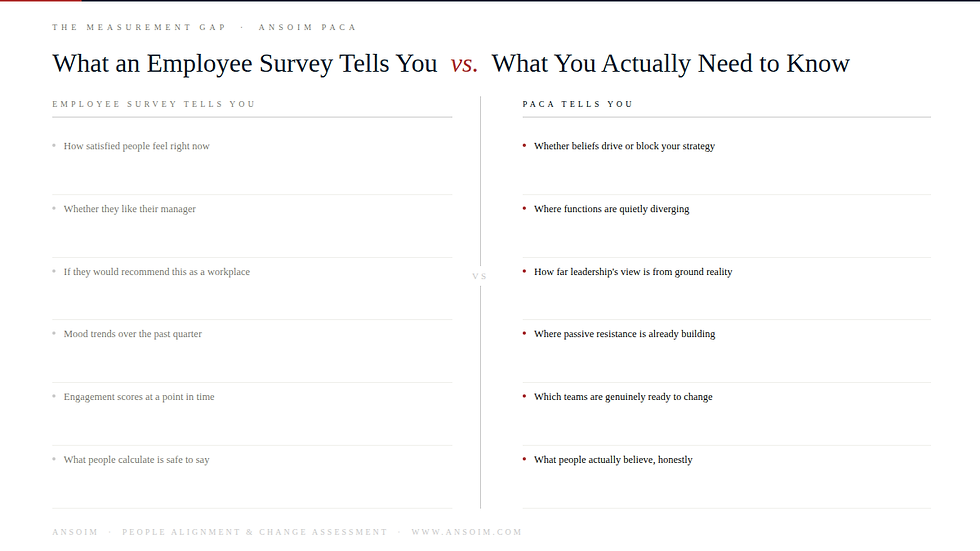
The difference between PACA and a traditional employee survey is not about one being more sophisticated than the other. It is about them being designed to answer completely different questions. Here is what that looks like when you put them side by side.
What You Want to Know | Employee Survey Tells You | PACA Tells You |
Are people ready to change? | How they feel about past management | Whether their beliefs and behaviours support change |
Why did our last initiative fail? | Engagement score dropped afterward | Where resistance was building and why, before it started |
Do functions share the same goals? | Teams report satisfaction independently | Exactly where and how goals are diverging across functions |
Does leadership see reality clearly? | Senior leaders score their own culture | The measurable gap between what leadership thinks and what the workforce lives |
Where do we intervene first? | A list of themes to improve across the board | A prioritised friction map showing where to act for maximum impact |
Can we trust the data? | People say what feels safe to say | Structural anonymity makes honesty the only rational choice |
Who is this for? | HR teams and engagement committees | CEOs, COOs, and transformation leads who need the truth |
The Question Worth Asking, If your employee survey showed strong engagement scores six months before your last initiative stalled, ask yourself what you would have done differently if you had known, before you launched, exactly where the misalignment was concentrated, which functions were not genuinely on board, and how far leadership’s perception of readiness was from the workforce’s reality. That is the question PACA is designed to answer.
How PACA Works: The Design Behind the Honesty
The most important design principle in any people diagnostic is this: the quality of the insight depends entirely on the honesty of the response. And honesty in an organisational context requires real psychological safety, not a procedural assurance that people do not quite believe.
Most employee surveys promise anonymity. Most participants know, from experience, that the promise is imperfect. When only twelve people in a team complete a survey and the manager knows it, anonymity is nominal. When HR can cross-reference responses with department and tenure and level, anonymity is structural fiction. And when people know that, they calibrate their answers accordingly.
PACA earns honesty through design, not through promise. The assessment requires no individual names, no email identifiers, no HR records, no financial data, and no operational data from the participating organisation.
No response can be linked to an individual or a subgroup. This is not a policy. It is a technical impossibility built into the architecture. The result is that PACA captures what people actually believe rather than what they calculate it is safe to report.
What the Assessment Covers
Each checkpoint presents five response options, calibrated to the five-level maturity architecture. Participants select the option that most accurately describes their lived experience of the organisation. Not their aspirations for it. Not the leadership narrative they have been given. Their actual, functional, daily reality.
Because responses are distributed across functions and levels, the data captures variance in a way a single aggregate score cannot. The report does not flatten the organisation into a number. It maps it.
What the PACA Report Delivers
Every participating organisation receives a single, unfiltered professional report. It contains the following.
Where misalignment is highest across functions and checkpoints, and where transformation risk is most concentrated.
The quantified gap between how leadership sees the organisation and how the workforce actually experiences it.
Which teams are genuinely ready for what is being asked of them, and which are not.
Where passive resistance and accountability gaps are quietly costing performance, before they surface in the numbers.
Where daily behaviour is diverging from declared priorities, and by how much.
Where to act first for the maximum alignment impact.
A CEO who reads this report walks away knowing the truth about their organisation. Often for the first time. That truth is not always comfortable. But it is actionable.
The organisations and leaders where PACA changes what is possible
PACA is not for every organisation at every moment. It is for organisations where the stakes of misalignment are high and the cost of proceeding without accurate people intelligence is consequential.
You are preparing for or running a transformation
Any business investing in a significant operational, cultural, or commercial change initiative benefits from knowing its alignment state before committing to a sequence. PACA tells you what the organisation is genuinely capable of absorbing and sustaining, and what must be addressed before the initiative can succeed.
Your last initiative did not hold
When a previous programme failed to sustain results, the reason almost always lives in the people layer. PACA identifies with precision whether the cause was perception variance, functional misalignment, passive resistance, or emotional unreadiness, and points to where this time needs to begin differently.
You are scaling fast and the culture is under pressure
Fast growth introduces alignment risk at a pace that outstrips informal cultural management. PACA shows you where the culture is holding under the pressure of growth and where it is beginning to fracture. The difference between discovering a fault line after it breaks and managing it before it does is the difference between a crisis and a calculated intervention.
You are a family business navigating professionalisation
The transition from a founder-led culture to a professionally managed organisation is one of the most alignment-sensitive changes any business makes. The informal beliefs and behavioural norms that defined the organisation do not dissolve because a new structure has been designed. PACA maps those systems so the transition can be managed with intelligence rather than assumption.
The Leaders PACA Is Built For
Who suspect that their strategy is not being executed the way they believe it is.
Who are frustrated that operational improvements are not sustaining beyond the initial deployment period.
Who want to move beyond mood surveys to genuine behavioural intelligence about their organisation.
Who need to sequence change management interventions correctly from the outset, not correct them later.
Who need rapid value creation with inherited teams whose alignment state is unknown.
The question is no longer whether your people are engaged. It is whether your organisation is aligned. Those are different questions. And for organisations that are serious about change, they demand a different answer.


Comments