People Alignment - The Silent Tax on Every Transformation
Experience across 200+ organisation in 34 industries consistently points to the same uncomfortable finding: the majority of transformation failures have little to do with flawed strategy or inadequate technology.
They fail because the people who must carry change forward are not genuinely aligned with it. This paper examines the anatomy of people misalignment, what it looks like at the leadership table, what it feels like on the production floor, and what it costs on the income statement. It draws on behavioural science, organisational psychology, and hard-won implementation experience to argue that misalignment is not a culture problem.
It is a precision measurement problem. And like any measurement problem, it is solvable. For CEOs preparing to launch, sustain, or rescue a transformation initiative, the central question is no longer 'Do we have the right strategy?' It is: 'Do we have the diagnostic clarity to know whether our people are truly ready or merely compliant?'
Download The Whitepaper on People Alignment
The Transformation Paradox
The Transformation Paradox - Why Smart Strategy Dies in Execution
Every year, organisations pour billions into transformation programs. New ERP systems. Lean frameworks. Sales restructures. Operational excellence journeys. And every year, a majority of those programs underdeliver, not because the roadmap was wrong, but because the people who needed to walk it were never truly on board.The observations are not comfortable. Across extensive implementation experience spanning manufacturing, pharmaceuticals, automotive, FMCG, chemicals, and financial services, a consistent pattern emerges: the large majority of major organisational change programmes fail to achieve their stated objectives within the projected timeframe. The popular response is to point at poor project management, inadequate training, or misaligned incentives. These are symptoms, not the root cause.
The root cause is simpler, and more unsettling. Most transformation programs are launched without a reliable, structured understanding of where the organisation's people actually stand — in their beliefs, their readiness, their level of ownership, and their trust in leadership's direction.
Executives proceed on assumptions.
They assume that because the strategy was communicated, it was understood.
They assume that because training was conducted, behaviour has changed.
They assume that because no one is visibly pushing back, resistance doesn't exist.
These assumptions are expensive.
~6 in 10 transformation programmes observed missing primary performance targets within the first year of launch | 3x higher sustained adoption consistently observed where employees demonstrated genuine ownership versus surface compliance | Wide gap persistently observed between leadership's belief about team alignment and frontline employees' lived experience |
Substantial share of transformation rework costs traced to undiagnosed people misalignment rather than process or technology failure | Markedly higher transformation value realisation in organisations running structured readiness diagnostics before programme launch | Majority of mid-level managers observed to receive strategic direction without meaningful input on execution feasibility |
Figure 1: Transformation performance observations — synthesised from ansoim SME closed-group discussions. See Data Attribution Note.
The most dangerous misalignment in any organisation is not the person who argues back — it is the person who nods and does nothing. Visible compliance is not organisational alignment.
For a CEO, this creates a structural problem. The very mechanisms by which you normally sense the health of your organisation, management reporting, town halls, leadership feedback, performance reviews, are optimised to surface compliance, not conviction. They are designed to tell you that people are doing what they are supposed to be doing. They are not designed to tell you whether people believe in it, own it, or will sustain it when the spotlight moves to the next initiative.
The organisations that consistently succeed in transformation that build genuine operational resilience, that maintain momentum long after the consultants have left, have figured out something their peers have not. They treat alignment not as a cultural aspiration, but as a measurable, manageable organisational variable. They do not guess at readiness. They diagnose it. And they act on what they find.
The Anatomy of Misalignment - What Leaders Cannot See
People misalignment is not one thing. It presents differently depending on where you look, which function you examine, and what stage of the transformation you are in. Understanding its anatomy is the first step towards being able to act on it precisely.Organisational psychologists have long understood that belief systems, not behaviour systems, drive sustainable performance. A person can comply with a new process while fundamentally disbelieving in its value. They will follow the procedure when observed. They will revert when they are not. This is the core of what makes misalignment so expensive and so hard to detect through conventional management observation.
The Four Layers of People Misalignment
Misalignment typically operates at four distinct layers, each with different causes, different symptoms, and different interventions.
The Four Layers of People Misalignment — Causes, Symptoms & Organisational Cost | |||
Layer | Where It Operates | Typical Symptom | Organisational Cost |
Strategic | C-suite to VP level | Direction articulated, not internalised | Conflicting functional priorities, budget battles |
Managerial | VP to frontline supervisor | Compliance signalled, conviction absent | Change programs stall at execution level |
Behavioural | Supervisors to operators | New process adopted, old habits persist | Quality failures, OEE degradation, SOP drift |
Cultural | Across the whole system | Values declared, not lived | Attrition, disengagement, innovation drought |
Figure 2: The four layers of people misalignment — each requires a different diagnostic lens and intervention approach
The layered nature of misalignment creates a compounding effect that is rarely appreciated by leaders until late in a transformation cycle. A strategic misalignment between the CEO and divisional heads creates ambiguity that middle managers fill with their own interpretation. Those interpretations diverge at the supervisory level. By the time the initiative reaches the shopfloor, four different teams may be executing four different versions of the same strategy, all of them technically compliant, none of them coherent.
The Role of Informal Organisation Structure
Every organisation has two structures: the one on the org chart, and the one that actually makes things happen. The informal architecture, the unofficial influencers, the trusted voices, the people whose opinion shapes the room's mood before the meeting starts, is typically more powerful than formal hierarchy in determining whether change lands or stalls.
Collective observation across programmes consistently confirms that a relatively small number of individuals in any organisation account for a disproportionate share of cultural momentum in either direction. These informal leaders can accelerate transformation dramatically when they are aligned with the programme direction, and they can quietly stall it when they are not. Most change programmes never map these networks. Most do not even acknowledge they exist.
The informal influencer who is not aligned with change is not your opponent. They are a diagnostic signal — telling you that something in the alignment architecture has not yet been resolved.
This is one of the most reliably underutilised insights in organisational transformation. The path to genuine change momentum does not run through the org chart. It runs through the invisible web of trust and influence that sits beneath it. Diagnosing that web, understanding who carries informal authority, in which direction their beliefs are currently pointing, and what would shift their conviction, is one of the highest-leverage investments a CEO can make before, not after, launching a change program.
The function-by-function reality of misalignment is equally important to understand.
In manufacturing operations, misalignment most often manifests as SOP drift, procedures followed when audited, ignored when not.
In sales organisations, it appears as CRM adoption metrics that look healthy on a dashboard while field teams continue to work relationships through informal channels.
In supply chain, it shows up in S&OP meetings that are attended but not owned, where numbers are presented without accountability for what happens when the numbers are wrong.
In HR and people functions, it lives in the gap between stated values and daily management behaviour.
The Three Change Readiness Failure Modes - That Derail Change Programs
In studying transformation failures across industries, three failure modes appear with enough consistency to warrant specific naming. Each is predictable. Each is detectable in advance. And each can be mitigated — if you know to look for it.Failure Mode 1: The Compliance Illusion
The compliance illusion occurs when an organisation mistakes process adoption for cultural alignment. A new process has been rolled out. Training has been conducted. Audits show compliance rates above 80%. Leadership declares the change embedded. Six months later, performance metrics reveal that the process is being followed in form but not in spirit and that the underlying problem it was designed to solve remains unresolved.
The compliance illusion is particularly seductive because it produces exactly the kind of metrics that management reporting systems are designed to capture. Completion rates. Audit scores. Attendance records. What these metrics do not capture is the quality of belief behind the behaviour. A team that complies because they have to will find a hundred ways to minimise the effort invested. A team that believes that genuinely owns the change, will find a hundred ways to make it work better.
Failure Mode 2: The Middle Manager Squeeze
Middle managers are the transmission mechanism of every organisational change. They receive strategy from above and must translate it into daily action below. They are the most important determinant of whether a transformation succeeds at the execution level and they are systematically underserved by most change management approaches.
The middle manager squeeze occurs when change is designed at the top and deployed at the bottom without adequately addressing the conviction, capability, and bandwidth of the layer in between. Middle managers who do not deeply believe in a change initiative will not actively undermine it. They do something more damaging: they deprioritise it. They answer questions about it with enough ambiguity to protect themselves from being wrong. They give it partial attention. And they signal to their teams, through micro-behaviours that no dashboard will ever capture, that this too shall pass.
Pattern observation across dozens of change programmes consistently surfaces the same finding: the single strongest predictor of frontline adoption is not the quality of the training programme or the strength of the incentive structure it is whether the direct manager demonstrates genuine belief in the change. Not stated support. Demonstrated belief, observable in daily decisions and language.

Failure Mode 3: The Trust Deficit
Trust is the invisible infrastructure of every organisation. It is not recorded on any balance sheet, but its presence or absence determines the velocity at which information travels, decisions get made, and change takes hold. Organisations with high institutional trust can absorb the disruption of transformation and continue to function. Organisations with low institutional trust cannot.
The trust deficit failure mode is the most structurally dangerous of the three because it is the hardest to rebuild once depleted. It typically develops across three dimensions simultaneously:
trust in leadership intentions (do senior leaders mean what they say?);
trust in organisational fairness (are decisions made consistently and equitably?); and
trust in the sustainability of change (will this still matter in six months?).
When all three are compromised, the organisation enters a defensive posture that virtually guarantees execution failure.
What makes the trust deficit particularly difficult to diagnose through conventional means is that it does not announce itself. People in low-trust environments do not tell their managers they don't trust the organisation. They simply become more careful, more guarded, less willing to take initiative, less likely to surface problems early.
The organisation becomes slower and more brittle and leadership, interpreting this as a performance management challenge rather than a trust problem, typically responds with more monitoring and more pressure, which makes the trust deficit worse.
The organisation that cannot measure where its trust deficit sits cannot target the interventions that would repair it. Trust repair without precision is expensive, slow, and frequently ineffective.
From Perception to Performance - Quantifying the Alignment Gap
The most consequential insight in alignment science is also the simplest: what your leaders believe is true about your organisation and what your frontline employees experience as true are rarely the same thing and the distance between them directly predicts your transformation risk.This gap between leadership perception and operational reality is not a product of bad intentions. It is a structural feature of hierarchical organisations. Information travelling upward gets filtered at every level. Problems get softened before they reach the senior team. Progress gets highlighted, setbacks get minimised. The result is that the picture of the organisation that leaders carry in their heads is systematically more optimistic than the picture that employees live every day.
Measuring this gap precisely is one of the most powerful diagnostic tools available to a CEO entering a transformation program. It tells you not just that alignment problems exist, but where they are most acute, which functions are most at risk, which dimensions of culture and readiness require the most urgent intervention, and which can be built upon as genuine strengths.

Figure 5: Perception gap analysis — gaps above 0.5 on a 5-point scale represent significant misalignment risk zones
The pattern that emerges from systematic perception gap analysis is illuminating. Leaders consistently overestimate middle manager alignment, believing that the management layer is more convinced and more capable of carrying change than it actually is. They simultaneously underestimate the effectiveness of informal influence networks not realising how much cultural momentum, in either direction, flows through the people who hold no formal authority.
The Science Behind People Readiness - What Rigorous Diagnostic Assessment Requires
Not all assessments are equal. The history of organisational diagnostics is littered with well-intentioned but fundamentally limited tools, engagement surveys that measure mood, 360-degree feedback mechanisms that measure reputation, and pulse surveys that measure the weather. A serious assessment of people readiness for transformation requires something more demanding.The psychometric foundations of robust alignment assessment draw on several decades of research in industrial and organisational psychology, change management, and behavioural economics. Three principles are foundational.
Principle 1: Measure Beliefs, Not Just Behaviours
Behavioural measurement tells you what people are doing. Psychometric measurement tells you why. The distinction matters enormously in the context of transformation, because behaviour that is driven by compliance pressure will not sustain when pressure is removed, while behaviour that is driven by genuine conviction will. An assessment designed to inform transformation strategy must reach below the behavioural surface to the belief systems, mental models, and cultural norms that determine whether a changed behaviour will become embedded or erode.
Principle 2: Capture Function-Level, Hierarchy-Level Variance
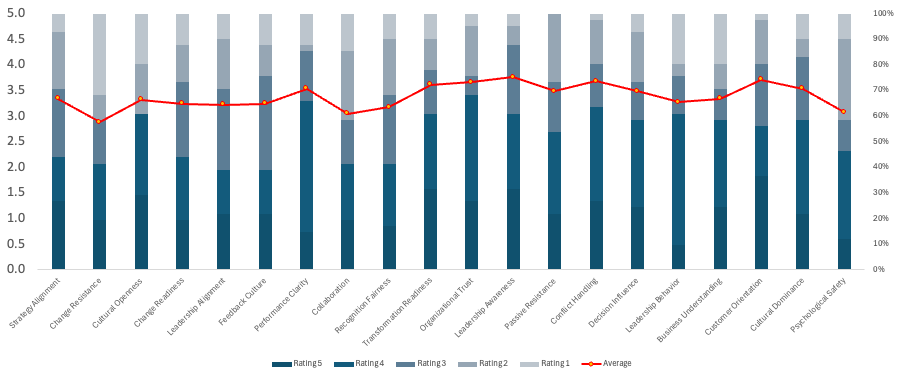
Organisational averages are almost always misleading. An organisation that scores 3.1 out of 5 on change readiness may have a high-performing manufacturing team operating at 4.2 and a supply chain function struggling at 2.0. An average-based report tells the CEO the organisation is middling. A function-level, hierarchy-level report tells the CEO where to intervene and where to build on existing strength.
This cross-sectional granularity is not achievable through conventional town halls or focus groups. It requires structured assessment instruments deployed across functions and levels simultaneously, with sufficient response volume to produce statistically meaningful sub-group analysis. The minimum viable sample size for function and hierarchy cross-tabulation is typically 40 to 80 participants for organisations of up to 500 people, scaling upward proportionally for larger organisations.
Principle 3: Assess Across the Full Transformation Readiness Landscape
Transformation readiness is multi-dimensional. An organisation can have excellent clarity on production targets while having deep dysfunction in how it manages cross-functional conflict. It can have a high-performing supply chain that operates in structural isolation from commercial planning. It can have formally documented values that are entirely absent from day-to-day management behaviour.
A serious diagnostic instrument (like PACA) must cover the full landscape of transformation-critical dimensions: functional knowledge and clarity, ownership of accountability, cross-functional collaboration patterns, change attitude and readiness, feedback and communication culture, recognition and trust architecture, and the specific operational practices relevant to each function. Anything less produces a partial picture — and partial pictures lead to partial interventions that address the visible while leaving the invisible intact.

What Mature Alignment Looks Like - The Five Stages of Organisational Alignment
Alignment is not binary. It exists on a continuum, and understanding where your organisation sits on that continuum and what movement along it looks like, is the foundation of a realistic and achievable transformation strategy.Decades of working inside complex organisations across industries has produced a clear picture of the five stages that organisations move through on the path from misalignment to genuine, self-sustaining organisational alignment. Each stage has a recognisable profile, predictable strengths and vulnerabilities, and a specific set of interventions that will create upward movement.

Figure 7: The five-stage alignment maturity model — each stage has a distinct behavioural signature and diagnostic profile
Stage 1: Ad Hoc — The Organisation Doesn't Know What It Doesn't Know
At Stage 1, alignment as a concept is not on the leadership agenda. The organisation operates in a state of managed fragmentation — functions pursue their own objectives, communication is reactive, and change initiatives are launched without diagnostic foundation.
The symptoms are familiar: high change fatigue, widespread scepticism, a history of initiatives that started with momentum and ended in quiet abandonment. Leadership interprets this as a performance management problem. It is, in fact, an alignment problem.
Stage 2: Aware — Surface Recognition Without Cultural Internalisation
Stage 2 organisations know they have an alignment challenge. It is discussed in leadership forums. Consulting firms have been brought in to look at culture and engagement. The analysis has been done. What is missing is the translation of that awareness into precise, actionable diagnostic clarity.
The organisation knows something is wrong but cannot pinpoint what, where, or in which direction to intervene. Change programs proceed on assumptions because the measurement infrastructure to replace assumptions with data does not yet exist.
Stage 3: Developing — Intent Without Consistent Execution
Stage 3 is where most organisations attempting transformation are located. There is genuine intent at the leadership level. Middle managers have been briefed and, in most cases, are intellectually supportive of the direction.
The challenge is consistency. Leadership modelling of the new culture is intermittent. Cross-functional collaboration happens under pressure but not as a default. The organisation experiences the classic two-speed problem: some functions and some teams are making genuine progress, while others are marking time.
Stage 3 is the most important place to measure, because the gap between Stage 3 and Stage 4 is where transformation either accelerates or stalls permanently. The organisations that move through Stage 3 decisively are the ones that have diagnostic clarity about which specific dimensions of alignment are holding them back, and who intervene with precision rather than broad-brush culture programs.
Stage 4: Structured — Alignment as an Engineered Outcome
Stage 4 organisations have made alignment an explicit management priority. They measure it. They review it in the same cadence as financial performance. Champions are emerging across functions — people who are genuinely energised by the direction and who carry that energy into their teams without being asked. Cross-functional friction has been explicitly mapped and is being actively reduced. Leadership behaviour and stated values are converging.
Stage 5: Institutionalised — The System Self-Sustains
Stage 5 is rare, and it looks different from what most people expect. It is not a state of perpetual harmony — it is a state of perpetual learning.
Conflict still exists, but it is surfaced constructively and resolved efficiently. Change is not resisted — it is anticipated and integrated.
The organisation has built what psychologists call high adaptive capacity: the ability to evolve its own mental models, practices, and culture in response to changing demands without experiencing the paralysis that characterises Stage 1 organisations in the same situation.
The CEO Playbook - From Diagnostic Insight to Transformation Action
Diagnosis without action is analysis. The value of understanding your organisation's alignment architecture lies entirely in what you do with that understanding. This section sets out the practical leadership agenda that follows from rigorous alignment assessment.The CEO's role in organisational alignment is not to be the chief cheerleader for change — it is to be the chief diagnostician. Your job is not to make people feel good about the transformation. It is to build the conditions under which genuine alignment becomes possible, by removing the structural obstacles that prevent it.
Priority 1: Make the Invisible Visible
The first leadership obligation that flows from alignment assessment is to surface what has been silent. Passive resistance, disguised as procedural diligence. Fear of speaking up, disguised as professional discretion. Lack of ownership, disguised as role clarity. These phenomena exist in virtually every organisation. The act of measuring them of naming them formally, in a structured diagnostic, with protected anonymity, is itself an intervention. It signals to the organisation that leadership is serious enough about these issues to look at them honestly.
The specific diagnostic insights that matter most for CEO action are: the size and location of the perception gap between leadership and frontline; the distribution of alignment maturity across functions; the specific dimensions of culture and readiness that are operating below a level that would support sustainable transformation; and the identification of informal influence networks and which direction those networks are currently pointing.
Priority 2: Intervene at the Middle
Given the evidence on middle management as the primary transmission mechanism of change, investment in middle manager conviction is the highest-leverage use of CEO attention in the early stages of any transformation program. This is not about training. It is about genuine engagement with the concerns, uncertainties, and personal calculations that middle managers are making when they decide how much of themselves to invest in a new initiative.
Effective middle manager alignment requires honest conversation about what the transformation will mean for their roles, their teams, and their personal trajectories. It requires visible modelling from the senior team — not just stated support, but observable behaviour change at the executive level that gives middle managers something real to point to when their teams ask whether leadership is serious this time. And it requires creating the psychological safety for middle managers to surface concerns and obstacles before they become execution failures.
Priority 3: Convert Informal Leaders to Alignment Champions
Once the informal influence network has been mapped, the strategic question becomes: which of these individuals are currently aligned with the transformation direction, and what would it take to convert those who are not? Converting an informal leader is not the same as winning an argument. It requires understanding what they actually believe about the organisation, what they have seen fail before, and what evidence would genuinely shift their conviction.
Informal leaders who become alignment champions are more valuable than any amount of top-down communication. They carry the change into the spaces that formal communication does not reach: the canteen conversations, the mobile chat groups, the informal debriefs after the all-hands meeting. Investing time and genuine engagement in these individuals is one of the most cost-effective transformation investments available.
Priority 4: Sequence Interventions by Diagnostic Priority
Not every alignment gap requires equal urgency. A sophisticated diagnostic reveals which dimensions are creating the most drag on transformation velocity and that analysis should directly drive intervention sequencing. Organisations that attempt to fix everything simultaneously typically fix nothing sustainably, because they diffuse their change management energy across too many fronts.

Figure 8: Intervention sequencing framework — diagnostic findings drive action priority. Timeframes are indicative and will vary by organisational context.
Priority 5: Measure Alignment Velocity, Not Just Current State
A one-time diagnostic produces a baseline. The organisations that drive the fastest transformation momentum use repeated measurement typically at 90-day intervals during active change programs to track alignment velocity: the rate at which the organisation is moving from its current maturity stage toward its target. This velocity tracking serves two purposes. It gives leadership a leading indicator of transformation performance, well before the lagging indicators of financial results and operational KPIs are available. And it allows intervention recalibration when velocity is lower than expected, before the situation has compounded into a more expensive problem.
The diagnostic cycle — measure, identify, intervene, remeasure is not complexity for its own sake. It is the application of the same scientific management discipline that most CEOs already apply to operational and financial performance, now applied to the human dimension of the organisation that those operational and financial results ultimately depend on.
Conclusion - The Competitive Advantage of Alignment Clarity
The organisations that will navigate the next decade of volatility, disruption, and relentless competitive pressure are not necessarily the ones with the best strategies. They are the ones with the greatest organisational agility — the capacity to align quickly, execute decisively, and adapt continuously.That capacity is not primarily a function of leadership charisma, organisational design, or the sophistication of the change management methodology chosen. It is a function of how well the organisation understands its own alignment architecture and how systematically it manages that architecture as a strategic asset.
The silent tax on transformation is real. It is measurable. And it is, with the right diagnostic foundation, largely preventable. The CEO who enters a transformation program with precise alignment intelligence is not just better positioned to succeed in that program they are building an organisational capability that will compound in value across every change initiative that follows.
The tools of organisational alignment science, psychometric assessment, perception gap analysis, informal network mapping, maturity staging, intervention sequencing are no longer the preserve of large multinationals with dedicated people science functions. They are accessible to any organisation serious enough to use them. The question is not whether your organisation has an alignment challenge. Every organisation does. The question is whether you are managing it with precision, or leaving it to chance.
Alignment is not a soft issue with hard consequences. It is a hard issue with a soft name. Measure it. Manage it. Build the competitive advantage that most of your competitors are still leaving on the table.
The path forward begins with a single, honest question: do you actually know where your people stand — in their beliefs, their readiness, their ownership, and their trust? Not what they say in a town hall. Not how they score on a quarterly engagement survey. What they genuinely think, feel, and believe about the direction you are asking them to follow.
If you don't know the answer to that question with precision, you are flying your transformation program on instruments that are not calibrated for the flight conditions. You may still land safely. But you are carrying more risk than you need to, and bearing more cost than you should.
The organisations that will look back on the next five years with pride are the ones that decided, now, to make alignment clarity a leadership discipline — not a cultural aspiration, not a consulting engagement, not a once-in-a-cycle exercise, but a repeating, rigorous, data-driven practice that sits at the heart of how they manage transformation and performance.
That decision is available to you today.
STATUTORY DISCLAIMER |
| |
| Purpose and Scope This white paper is produced solely for thought leadership, general informational, and educational purposes. It is intended to stimulate professional discussion and reflection among organisational leaders. Nothing in this document constitutes professional advice of any kind, including but not limited to management consulting advice, legal advice, financial advice, or investment advice. Readers should seek qualified professional consultant before making any organisational or business decisions. No Warranties While every effort has been made to ensure the accuracy, completeness, and relevance of the content contained herein, ansoim LLP makes no representation or warranty, express or implied, as to the accuracy, reliability, completeness, or fitness for any particular purpose of the information presented. All observations, patterns, and indicative data are based on the collective professional experience of ansoim SMEs and are provided on an 'as observed' basis. Results in any specific organisation will vary based on context, industry, size, culture, and a wide range of other factors. No Third-Party Attribution This document does not cite, reproduce, or rely upon data, findings, or intellectual property from any third-party research organisation, consultancy, academic institution, or published database. Any similarity to published research findings is coincidental and reflects the convergent nature of widely observed organisational phenomena. Intellectual Property This document, including all frameworks, models, diagnostic architectures, and written content, is the intellectual property of ansoim LLP. Reproduction, distribution, or adaptation of any part of this document for commercial purposes without the prior written consent of ansoim LLP is prohibited. Use for non-commercial educational or internal organisational discussion purposes is permitted provided that the source is acknowledged. Confidentiality of Client Observations No client-specific data, case study details, engagement findings, or identifiable organisational information has been included in this document. All patterns described are aggregated, anonymised, and presented at a level of generality that precludes identification of any specific organisation, individual, or engagement. | |


Comments