People Alignment (PACA) in Manufacturing: 2026 Outlook
Executive summary
Manufacturing organisations are operating in an era of unprecedented change density. Digital transformation, cost restructuring, organisational redesign, capability transitions, and sustainability imperatives are no longer sequential; they are simultaneous.
For many leadership teams, this is not a question of ambition or intent. It is a question of absorption capacity.
Despite significant investment and executive attention, execution outcomes remain uneven. Performance improvements stall. Initiatives lose momentum. Leaders sense growing distance between strategy rooms and shop floors, often without a clear explanation.
This paper argues that the primary constraint in contemporary manufacturing transformation is no longer technical capability or strategic clarity, but people alignment under sustained change. Specifically, outcomes increasingly depend on how strategy is interpreted across layers, how behaviour adapts under pressure, and how organisations carry emotional load over time.
Rather than offering prescriptions or checklists, this paper surfaces observable patterns and early signals that repeatedly distinguish organisations where change compounds performance from those where it quietly dissipates.
Many leadership teams recognise these signals intuitively. Few have a structured way to surface them before execution falters.
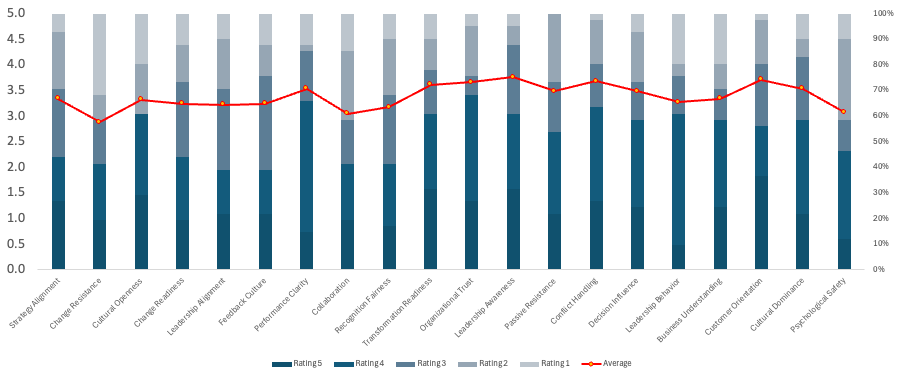
A shift in execution risk - People Alignment Index
For decades, transformation risk in manufacturing was dominated by tangible constraints: capital intensity, asset rigidity, process immaturity, and supply instability. These risks remain relevant, but most established organisations have learned to manage them.
What has risen in prominence is a different category of risk — interpretational and behavioural risk.
In complex organisations:
the same strategy is understood differently by different functions
the same change generates confidence in some layers and anxiety in others
the same process is followed formally yet bypassed informally
Execution weakens not because people disagree openly, but because meaning fragments silently.
This fragmentation is difficult to detect, rarely discussed in executive forums, and almost never captured by traditional performance metrics. Yet its impact on execution is decisive.
This is a correlation matrix — it shows how strongly two variables (in this case, PACA dimensions like Strategy Alignment, Change Resistance, Psychological Safety, etc.) move together. The numbers go from -1.0 to +1.0:
| Strategy Alignment | Change Resistance | Cultural Openness | Change Readiness | Leadership Alignment | Feedback Culture | Performance Clarity | Collaboration | Recognition Fairness | Transformation Readiness | Organizational Trust | Leadership Awareness | Passive Resistance | Conflict Handling | Decision Influence | Leadership Behaviour | Business Understanding | Customer Orientation | Cultural Dominance | Psychological Safety |
Strategy Alignment | 1.0 |
|
|
|
|
|
|
|
|
|
|
|
|
|
|
|
|
|
|
|
Change Resistance | 0.5 | 1.0 |
|
|
|
|
|
|
|
|
|
|
|
|
|
|
|
|
|
|
Cultural Openness | 0.5 | 0.4 | 1.0 |
|
|
|
|
|
|
|
|
|
|
|
|
|
|
|
|
|
Change Readiness | 0.3 | 0.2 | 0.2 | 1.0 |
|
|
|
|
|
|
|
|
|
|
|
|
|
|
|
|
Leadership Alignment | 0.4 | 0.4 | 0.4 | 0.2 | 1.0 |
|
|
|
|
|
|
|
|
|
|
|
|
|
|
|
Feedback Culture | 0.4 | 0.2 | 0.4 | 0.3 | 0.3 | 1.0 |
|
|
|
|
|
|
|
|
|
|
|
|
|
|
Performance Clarity | 0.4 | 0.2 | 0.3 | 0.1 | 0.5 | 0.4 | 1.0 |
|
|
|
|
|
|
|
|
|
|
|
|
|
Collaboration | 0.5 | 0.6 | 0.2 | 0.4 | 0.4 | 0.4 | 0.4 | 1.0 |
|
|
|
|
|
|
|
|
|
|
|
|
Recognition Fairness | 0.3 | 0.4 | 0.4 | 0.3 | 0.2 | 0.2 | 0.1 | 0.3 | 1.0 |
|
|
|
|
|
|
|
|
|
|
|
Transformation Readiness | 0.4 | 0.5 | 0.5 | 0.3 | 0.5 | 0.3 | 0.2 | 0.5 | 0.3 | 1.0 |
|
|
|
|
|
|
|
|
|
|
Organizational Trust | 0.5 | 0.1 | 0.3 | 0.1 | 0.5 | 0.2 | 0.2 | 0.1 | 0.3 | 0.1 | 1.0 |
|
|
|
|
|
|
|
|
|
Leadership Awareness | 0.2 | 0.3 | 0.4 | 0.1 | 0.4 | 0.3 | 0.3 | 0.2 | 0.2 | 0.2 | 0.4 | 1.0 |
|
|
|
|
|
|
|
|
Passive Resistance | 0.5 | 0.5 | 0.5 | 0.2 | 0.7 | 0.5 | 0.5 | 0.6 | 0.2 | 0.6 | 0.4 | 0.5 | 1.0 |
|
|
|
|
|
|
|
Conflict Handling | 0.3 | 0.3 | 0.4 | 0.2 | 0.5 | 0.2 | 0.2 | 0.3 | 0.3 | 0.5 | 0.5 | 0.4 | 0.5 | 1.0 |
|
|
|
|
|
|
Decision Influence | 0.4 | 0.3 | 0.5 | 0.2 | 0.5 | 0.5 | 0.2 | 0.3 | 0.1 | 0.4 | 0.4 | 0.4 | 0.6 | 0.3 | 1.0 |
|
|
|
|
|
Leadership Behaviour | 0.2 | 0.2 | 0.2 | 0.2 | 0.4 | 0.2 | 0.0 | 0.3 | 0.2 | 0.4 | 0.2 | 0.4 | 0.6 | 0.5 | 0.5 | 1.0 |
|
|
|
|
Business Understanding | 0.7 | 0.6 | 0.3 | 0.2 | 0.2 | 0.3 | 0.3 | 0.6 | 0.3 | 0.2 | 0.3 | 0.3 | 0.4 | 0.3 | 0.3 | 0.2 | 1.0 |
|
|
|
Customer Orientation | 0.4 | 0.3 | 0.5 | 0.1 | 0.5 | 0.2 | 0.5 | 0.3 | 0.1 | 0.4 | 0.4 | 0.6 | 0.5 | 0.4 | 0.4 | 0.2 | 0.3 | 1.0 |
|
|
Cultural Dominance | 0.6 | 0.4 | 0.5 | 0.1 | 0.6 | 0.4 | 0.4 | 0.5 | 0.2 | 0.6 | 0.4 | 0.3 | 0.7 | 0.5 | 0.5 | 0.6 | 0.4 | 0.5 | 1.0 |
|
Psychological Safety | 0.1 | 0.2 | 0.1 | 0.4 | 0.4 | 0.3 | 0.0 | 0.3 | -0.1 | 0.4 | 0.2 | 0.2 | 0.4 | 0.4 | 0.3 | 0.2 | 0.1 | 0.1 | 0.1 | 1.0 |
How change actually travels inside organisations
Change does not move linearly from leadership to the shop floor. It moves through a sequence of translations: intent to interpretation to prioritisation to behaviour
At each stage, translation is shaped by functional incentives, managerial experience, historical successes and failures, informal authority structures, and local norms.
Most organisations invest heavily in articulating intent. Far fewer systematically observe what happens after intent leaves the executive layer.
This explains a familiar leadership experience:
“The strategy was clear. The effort was real. But the organisation didn’t move the way we expected.”
The issue is rarely lack of clarity. It is loss of fidelity during transmission.

Five recurring alignment patterns across manufacturing environments
Across industries, geographies, and ownership structures, five patterns appear with striking consistency. They do not signal poor leadership. They signal structural blind spots.
Pattern 1: Strategy clarity does not guarantee shared priority
Strategic goals may be articulated clearly, yet functions prioritise them differently. Over time, local optimisation takes hold, efficiency over responsiveness, cost over resilience, output over flow.
The organisation remains active, disciplined, and busy. But enterprise impact fragments.
Signal: strong silo performance paired with weak end-to-end outcomes.
Pattern 2: Silence often substitutes for agreement
Low overt resistance is often interpreted as alignment. In practice, silence may indicate fear of consequences, fatigue from previous initiatives, or a belief that input will not influence outcomes.
In such environments, problems do not surface early, they surface late, and usually through numbers.
Signal: leadership learns about issues through dashboards, not conversations.
Pattern 3: Leadership intent weakens under operational pressure
Alignment at announcement is common. Alignment under stress is rare.
When delivery pressure increases, informal shortcuts reappear, exceptions become precedents, and behaviour drifts from stated values.
Teams observe these shifts quickly, often long before leaders do.
Signal: early momentum followed by quiet regression.
Pattern 4: Resistance rarely looks like resistance
In mature organisations, resistance is seldom emotional or confrontational. It appears as extended analysis, repeated clarification requests, procedural rigidity, and risk framing.
Each action is reasonable in isolation. Collectively, they slow execution without visible opposition.
Signal: decisions are delayed without being explicitly blocked.
Pattern 5: Emotional load accumulates across initiatives
Change fatigue is not driven by volume alone. It accumulates when initiatives fade without closure, when effort goes unrecognised, and when lessons are not integrated.
Over time, people continue to comply cognitively while disengaging emotionally.
Signal: execution continues, but ownership thins.
People Alignment Index Visit : People Alignment & Change Assessment™
Why common metrics fail to surface these risks - People Alignment Index
Most organisations rely on engagement surveys, training completion rates, milestone tracking, and KPI dashboards.
These tools are necessary but insufficient.
They are designed to track activity and output, not interpretation, behaviour under pressure, or emotional readiness for sustained change.
As a result, leadership intervention often comes after alignment has already eroded. By then, execution issues appear operational, even though their roots are behavioural.
What aligned organisations do differently — quietly
Organisations that sustain change across cycles rarely rely on grand change programs. Instead, they exhibit a small number of consistent behaviours.
They reduce priorities to explicit trade-offs, make disagreement visible and bounded, align incentives tightly with intent, address failed initiatives openly, and treat culture as a practical execution system rather than a philosophical construct.
Most importantly, they do not assume alignment.They observe it.
Middle management: the unseen alignment hinge
Across transformations, one reality persists: most alignment loss occurs in the middle of the organisation.
Middle managers balance delivery, stability, ambiguity, and team morale. Without explicit guidance, many act as buffers, absorbing change rather than transmitting it.
This buffering protects short-term stability. Over time, it weakens transformation.
Leadership teams that recognise this dynamic early are able to intervene constructively. Those that don’t often misdiagnose resistance elsewhere.

Culture as an execution force
Culture is visible in action: how quickly issues surface, how conflict is resolved, how exceptions are treated, and how leaders behave when trade-offs are uncomfortable.
In every organisation, culture already shapes execution. The only question is whether leadership understands how.
Ignoring culture does not neutralise it. It amplifies its influence.
People Alignment Index Visit : People Alignment & Change Assessment™
Implications for CEOs
Three implications stand out.
First, alignment must be observed continuously, not inferred from silence or reported progress.
Second, execution risk is behavioural before it is operational.
Third, people alignment is a core leadership discipline, not an HR initiative.
Leaders who treat alignment as an explicit area of attention gain earlier visibility, more credible execution, and greater organisational resilience.
Conclusion: the question that matters now
Manufacturing organisations are not failing because they lack strategy, systems, or effort.
They struggle because change now moves faster than alignment can naturally form.
The leaders who succeed are those who make alignment visible, honestly enough to learn, and consistently enough to sustain performance.
The central question for CEOs is no longer:
“Is the change launched?”
It is:
“Do we truly understand how our organisation is interpreting and carrying this change; before performance tells us too late?”
That question, when explored seriously, almost always leads to a deeper conversation.



Comments