Manufacturing Excellence Consulting: Lean, OEE and Continuous Improvement
Manufacturing enterprises rarely lose competitiveness through a single failure. They lose it gradually, through gaps between process design and shop-floor reality that go undiagnosed for years. ansoim’s Manufacturing Excellence practice closes that gap through direct process observation, data analysis, and full implementation ownership with the return on investment defined and tracked from the outset, not asserted at the end.

What Is Manufacturing Excellence?
Manufacturing excellence is the systematic pursuit of higher efficiency, quality, and productivity across a production operation, achieved through process transformation, waste reduction, workforce capability building, and disciplined governance. It draws on established methodologies, Lean, Six Sigma, and Total Productive Maintenance but its outcome is organization specific. A manufacturing operation that performs consistently with its own strategic goals, not against a generic industry benchmark.
Why ansoim?
ansoim takes full ownership of implementation rather than handing over a report and departing. We partner with all stake holders, from shop floor to boardroom, and implement change at a point of execution. We don’t force same solution to different problems, rather all our To-Be solutions are customized to specific client challenges. Our people are having extensive hands-on experience in operational excellence & change management implementation across continents and divers industries landscapes.
The Business Challenges ansoim Address
Manufacturing leaders typically bring one or more of the following challenges to ansoim;
-
Persistent gaps between planned and actual production performance
-
Hidden losses in Overall Equipment Effectiveness that are not visible in standard reporting
-
Quality and rework costs that erode margin without a clear root cause
-
Improvement initiatives that generate short-term gains but do not sustain
-
A workforce that is not aligned with, or engaged in, the transformation agenda
-
Unplanned equipment downtime and recurring maintenance issues that reduce capacity, disrupt production schedules, and increase operating costs.
-
Fragmented operational data across machines, ERP, MES, and spreadsheets, preventing a single source of truth for decision-making.
-
Artificial Intelligence and digital initiatives that fail to deliver measurable business value because of poor data quality, unclear use cases, or limited organisational adoption.
-
Limited real-time visibility into production, quality, maintenance, and material flow, resulting in reactive decisions instead of proactive operational management.
.png)
Our Approach to Manufacturing Excellence
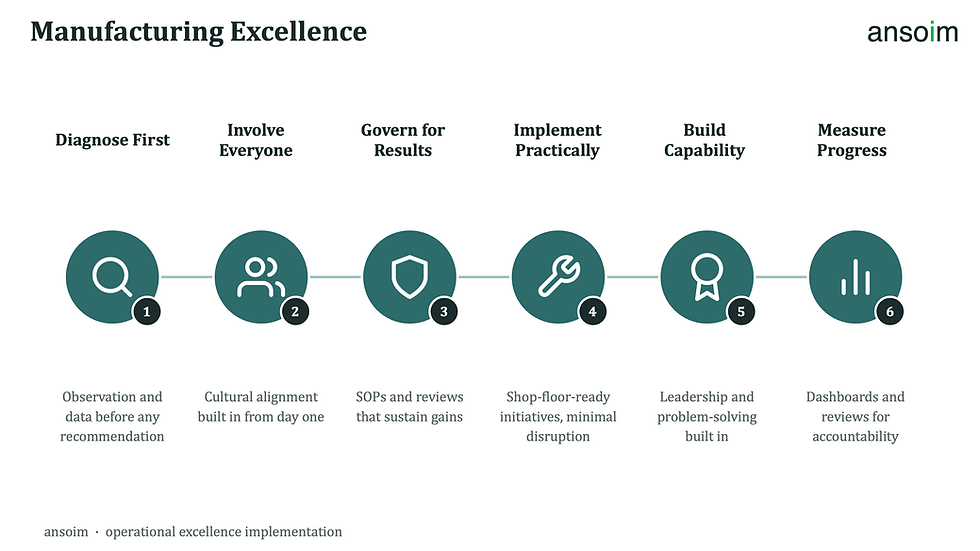
Before any recommendation is made, ansoim’s consultants examine operational data, walk the production process directly, prepare details process & system analysis and speak with personnel from the shop floor to the leadership team. This combination surfaces gaps that single-source diagnostics — data alone, or interviews alone — consistently miss.
Transformation that is imposed top-down rarely holds. ansoim builds buy-in across every level of the organisation from the start, treating cultural alignment as a design requirement of the programme, not an afterthought.
Improvement without governance regresses. ansoim establishes the standard operating procedures, review cadences, and ownership structures required for gains to persist after the engagement ends.
Recommendations create value only when they are implemented effectively. ansoim focuses on practical, shop floor-ready solutions that can be adopted within existing operational environments. Every initiative is designed to minimise disruption while delivering measurable improvements in productivity, quality, cost, delivery, and safety.
Sustainable transformation requires internal ownership. Throughout the engagement, ansoim works alongside operational teams to develop leadership capability, strengthen problem-solving skills, standardise best practices, and enable employees to continuously improve performance long after the engagement concludes.
Operational improvement must be visible and measurable. ansoim establishes clear performance indicators, real-time dashboards, structured review mechanisms, and milestone tracking to monitor progress, identify emerging risks, and ensure accountability throughout the transformation journey.
Gap Analysis and Diagnostics
A structured assessment of current-state process effectiveness, compliance, and governance maturity, producing a prioritised, strategically aligned improvement roadmap.
Lean and OEE Implementation
Direct implementation of Lean principles and Overall Equipment Effectiveness improvement, targeting cycle time, hidden loss, and first-pass yield.
Quality Performance Improvement
Statistical Quality Control programme design, reducing rework and improving production yield through process reengineering, system improvement, and people alignment.
Maintenance Performance Improvement
Reliability-centred maintenance programme design, reducing unplanned downtime and extending asset life through Mean Time Between Failures and Mean Time to Repair improvement.
Production Planning and
Operational Control
Design and implementation of structured production planning, scheduling, Short Interval Control (SIC), visual management, performance dashboards, and daily review systems to improve schedule adherence, operational visibility, and on-time delivery.
Digital Manufacturing and Performance Analytics
Integration of operational data, manufacturing systems, and real-time performance dashboards to improve decision-making, identify performance deviations early, and enable data-driven continuous improvement across the manufacturing operation.
Cultural and Change Alignment
Structured engagement across the workforce to build ownership of the transformation agenda, reducing resistance and improving adoption speed.
Service Offerings and Capabilities
19%
Improvement in Productivity
15%
Improvement in OEE
25%
Reduction in Downtime
Business Benefits
-
Measurable reduction in hidden production losses and rework cost.
-
Improved resource allocation, with time, capital, and manpower directed to the highest-impact initiatives.
-
A governance structure that sustains gains after the engagement concludes.
-
Financial returns defined and tracked from the start of the engagement, not asserted retrospectively.
-
Typical client outcomes include 10–30% output improvement and 15–50% defect-rate reduction, with timelines and magnitude varying according to starting operational maturity.
-
Improved production planning and schedule adherence, resulting in more predictable operations and higher on-time delivery performance.
-
Higher equipment reliability and Overall Equipment Effectiveness (OEE) through better maintenance practices, reduced downtime, and improved asset utilisation.
-
Greater operational visibility through standardised KPIs, dashboards, and performance reviews, enabling faster, data-driven decision-making.
-
Enhanced workforce capability and accountability through standardised work, skill development, and a culture of continuous improvement that supports long-term operational excellence.
Manufacturing Excellence Metrics We Track
Production Efficiency
Measures how much of planned production time is used to produce good output. Tracked through OEE, Cycle Time, Units Produced per Hour, and Hidden Loss.
Maintenance Reliability
Tracks how often equipment fails and how quickly it is restored to service. Tracked through Mean Time Between Failures (MTBF), Mean Time to Repair (MTTR), and Downtime.
Inventory Management
Measures how efficiently raw materials and finished goods move through the operation. Tracked through Inventory Turnover Ratio, Days of Inventory on Hand, and Stock Accuracy.
Continuous Improvement (Kaizen)
Tracks the volume and financial impact of incremental process improvements. Tracked through Number of Kaizen Initiatives, Cost Savings from Improvement Projects, and Time to Implement.
Quality Management
Measures the cost and frequency of defects across the production process. Tracked through First Pass Yield, Defect Rate, and Cost of Poor Quality.
Lean Manufacturing
Tracks how much of process time and material adds customer value versus waste. Tracked through Lead Time Reduction, Waste Reduction Percentage, and Value Stream Ratio.
Workforce Productivity
Measures output generated per labour hour. Tracked through Units Produced per Labour Hour, Labour Utilisation Rate, and Training Hours per Employee.
Data Utilisation
Tracks how much of operational decision-making is driven by data versus judgement. Tracked through Data Accuracy Rate, Percentage of Data-Driven Decisions, and Data Culture in Decision Management.


