Operational Maturity as a Strategic Lever
Why Leading Manufacturing Organizations Are Benchmarking Themselves Before the Market Does?
Executive Summary
In boardrooms across manufacturing, strategy conversations are increasingly sophisticated. Growth vectors are defined. Capital allocation is debated. Digital roadmaps are approved.
Yet a quieter, more consequential variable often remains unexamined: execution maturity.
Not whether targets are achieved but whether the system that produces those targets is robust, scalable, and resilient under stress.
As volatility intensifies across supply chains, energy markets, labor pools, and customer demand, operational maturity is emerging as a structural differentiator. Organizations that benchmark and institutionalize it early are building a compound advantage. Those that do not often discover their fragility only when performance falters.
This article explores why operational maturity assessment (Operational Maturity as a Strategic Lever) has become a strategic imperative and how forward-looking CXOs are using it to de-risk growth, unlock margin, and strengthen valuation.

The Shift from Performance to Predictability - Operational Maturity as a Strategic Lever
For decades, operational excellence was equated with output metrics: OEE, yield, cost per unit, OTIF, inventory turns.
These remain important. But they are lagging indicators.
Two organizations can report identical performance metrics. Yet beneath the surface, their systems may differ dramatically:
One operates with institutionalized governance, predictive controls, integrated planning, and data integrity.
The other relies on experienced managers, informal escalation, and reactive problem-solving.
In stable markets, both may perform adequately.
In volatile markets, only one sustains performance who used Operational Maturity as a Strategic Lever
The strategic question for CXOs is therefore shifting from:
“Are we performing?”
to:
“How predictable is our performance engine under pressure?”
Operational maturity assessment provides a structured way to answer that question.
Margin Compression Is Exposing Structural Weakness
Manufacturing organizations today face simultaneous pressures:
Commodity and energy volatility
Supply chain fragmentation
Increased working capital intensity
Digital disruption
Skilled talent attrition
In such an environment, inefficiencies that once remained invisible are now amplified.
Margin compression is rarely the result of a single operational failure.
It is typically the cumulative effect of systemic immaturity:
Planning cycles disconnected from demand variability
Variance reviews focused on explanation rather than redesign
Maintenance programs that are calendar-based rather than reliability-driven
Data inconsistencies between shopfloor capture and executive dashboards
KPIs tracked without ownership clarity
These patterns do not appear dramatic in isolation. Over time, however, they create structural drag.
Organizations that fail to assess their maturity risk confusing effort with effectiveness.
Pillar | Manufac | SCM | Sales | People | Pillar Score |
Strategy | 🟡 | 🟢 | 🟡 | 🔴 | 63 |
Process | 🟡 | 🔴 | 🟡 | 🟢 | 58 |
Data | 🔴 | 🟡 | 🔴 | 🟡 | 49 |
Integration | 🟡 | 🟡 | 🟢 | 🔴 | 61 |
Behavior | 🔴 | 🟡 | 🔴 | 🟡 | 52 |
The Leadership Blind Spot
At senior levels, information is necessarily summarized. Dashboards are aggregated. Variance is contextualized. Reports are filtered.
The unintended consequence is a blind spot.
Executives typically review outcomes, not the structural quality of the processes generating those outcomes.
Consider three diagnostic questions:
If key managers left tomorrow, would operational stability hold?
If capacity expanded by 25 percent, would systems absorb complexity or fracture?
If demand volatility doubled, would planning and procurement recalibrate seamlessly?
Few organizations have objectively tested these assumptions.
Operational maturity assessment challenges leadership narratives by examining the institutionalization of performance not just the current state of results.
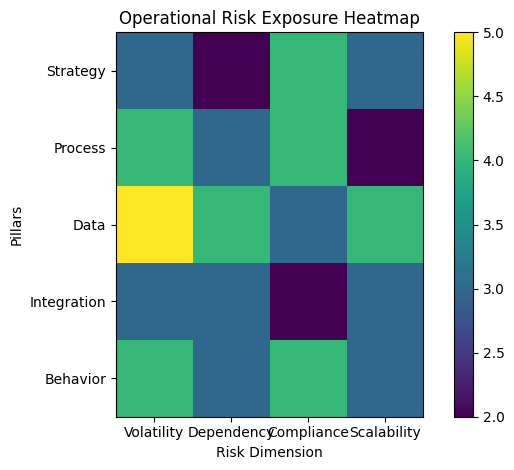
What Operational Maturity Actually Measures
Contrary to common perception, maturity assessment is not a compliance exercise or a qualitative review. At its best, it is a granular evaluation of systemic robustness across multiple dimensions.
Five structural pillars are particularly consequential.
1. Strategy-to-Execution Alignment
High-performing organizations translate corporate objectives into operational discipline.
Assessment evaluates:
Clarity of KPI cascade from board to shopfloor
Alignment between capital allocation and operational bottlenecks
Effectiveness of governance forums in driving decision-making
Misalignment often manifests subtly targets achieved in isolation but at cross-functional cost.
2. Process Depth and Standardization
Surface-level process documentation does not equate to maturity.
A rigorous assessment examines:
Scientific basis of standard times and capacity calculations
Depth of root cause analysis beyond first-level explanation
Institutionalization of preventive and predictive maintenance
Mechanisms for horizontal deployment of improvements
The question is not whether processes exist but whether they are robust, data-driven, and continuously refined.
3. Data Integrity and Decision Architecture
Data maturity is foundational.
Organizations frequently invest in dashboards and ERP systems, yet underlying data accuracy remains inconsistent.
Assessment typically probes:
Accuracy at source capture
Latency between event occurrence and reporting
Traceability of KPI definitions
Reliance on manual reconciliation
If data is unreliable, decision-making becomes assumption-driven. In volatile environments, that risk compounds quickly.
4. Cross-Functional Integration
Silo optimization is a persistent challenge.
Assessment explores:
Synchronization between sales forecasting and production planning
Procurement strategies evaluated on total cost rather than unit price
Inventory buffers driven by fear rather than analytics
Alignment between digital initiatives and process readiness
Organizations that excel at integration often unlock disproportionate gains without additional capital investment.
5. Behavioral and Cultural Embeddedness
Perhaps the most underestimated dimension is behavioral maturity.
Systems are sustainable only when supported by institutional behaviors:
Clear accountability frameworks
Structured problem-solving methodologies
Transparent performance review mechanisms
Measurable change readiness
If performance depends disproportionately on individual heroics, structural maturity is limited regardless of headline profitability.

Timing: Why “Now” Is Often the Right Moment
Many organizations initiate maturity assessments reactively during crisis or margin erosion.
The more strategic approach is proactive benchmarking during relative stability.
Critical inflection points include:
Pre-expansion or greenfield investment
Before major digital transformation programs
Following acquisition or integration
During leadership transition
When EBITDA growth decouples from revenue growth
In each scenario, maturity assessment functions as risk mitigation identifying structural gaps before they become financial liabilities.
From Assessment to Strategic Advantage
A well-designed operational maturity assessment delivers more than diagnostic insight. It creates enterprise-wide alignment around objective reality.
Three outcomes are particularly valuable.
1. Quantified Visibility
Subjective debates give way to structured scoring and benchmarking.
Leadership gains clarity on where structural gaps exist and their potential impact.
2. Prioritized Transformation Roadmap
Not all gaps warrant equal attention.
Assessment frameworks typically categorize improvement opportunities by impact and implementation complexity, enabling sequenced transformation rather than scattered initiatives.
3. Cultural Reset Toward Institutionalization
When maturity becomes measurable, conversations shift from blame to system design. This reduces defensiveness and increases collective ownership.
Organizations that institutionalize this discipline often find that performance volatility decreases even before major interventions are implemented.

The Cost of Avoidance
Avoiding structured assessment may feel comfortable in the short term.
However, absence of objective benchmarking carries risks:
Overestimation of operational robustness
Undetected dependency on key individuals
Hidden inefficiencies embedded in routines
Capital deployed into immature systems
Delayed response to competitive shifts
In highly competitive sectors, advantage increasingly accrues to organizations that measure what others assume.
A Competitive Imperative - Operational Maturity as a Strategic Lever
Operational maturity is not visible in marketing materials. It is rarely discussed in earnings calls.
Yet it is frequently the underlying reason why some manufacturers:
Scale seamlessly across geographies
Integrate acquisitions efficiently
Digitize without disruption
Maintain margin resilience during shocks
The compounding effect of institutionalized execution discipline is difficult to replicate quickly.
Organizations that benchmark themselves early create a structural moat.
Those that delay may find themselves benchmarking reactively after performance has already signaled weakness.
Conclusion: A Board-Level Question
In an era defined by volatility, the central leadership question is no longer solely about strategy formulation.
It is about system robustness.
Before the market tests your resilience, before competitors expose structural gaps, before investors demand deeper transparency, a fundamental question deserves objective examination:
How mature is our execution engine, truly?
Operational maturity assessment is not an operational initiative.
It is a strategic instrument for risk mitigation, margin expansion, and long-term competitiveness.
The organizations that recognize this early are quietly building advantage.
The rest may discover the cost of immaturity only when volatility reveals it.



Comments