The Quiet Factories, Why Manufacturing Excellence Fails in 2026
Updated: Mar 11
We have stood in a lot of factories.
Steel plants in Odisha at two in the morning. Pharmaceutical lines in Pune during a quality crisis. Auto ancillary shops in Chennai trying to hold customer schedules while their tier-one supplier was three days late. Garment units in Surat where the owner was genuinely convinced his operations were world-class and where a two-hour walk-through told a completely different story.
After 200+ projects — walking lines, sitting in shift-handover meetings, standing in front of whiteboards with operations heads at midnight, we have arrived at one conclusion.
The most dangerous factories are not the ones that are obviously broken. The most dangerous factories are the ones that look fine.

The Factory That Looks Fine, You know this factory. You may run it.
The metrics are acceptable. Shipments go out. Customers are not escalating. The MD does a monthly plant walk and people are busy. There are improvement initiatives underway, a few Kaizen projects, a new ERP module being implemented, a TPM programme that started eight months ago. The safety record is reasonable. The P&L is not alarming.
And yet.
If you have spent real time in manufacturing, not visiting but working, you can feel something in these plants that the dashboard does not show.
A certain heaviness in the shift-handover meeting where nobody quite says what actually happened.
A maintenance supervisor who has learned to describe every breakdown as a "minor stoppage" because the plant manager does not like bad news.
A production team that hits its daily number by pulling forward tomorrow's schedule, quietly, every single day, and has been doing it for two years.
The line runs. The numbers are green. The factory is slowly eating itself.
This is the quiet factory. And in 2026, it is far more common than the industry would like to admit.

What We Actually See When We Walk In
When we enter a plant, we are not looking at the equipment first. Equipment tells you very little on its own.
We are watching people.
We are watching whether the shift supervisor walks the line or sits at his desk. We are watching whether the quality inspector is treated as a production partner or an obstacle. We are watching what happens in the ten minutes after a machine goes down who moves, who calls whom, whether the response is rehearsed or improvised. We are watching whether the maintenance team and the production team talk to each other like colleagues or like opposing lawyers.
We are watching the noticeboards. Not what is on them but whether anyone has looked at them recently. A performance board where last month's numbers are still displayed in mid-October is not a performance board. It is wallpaper.
We are watching the MD's driver. Seriously. The driver often knows more about the real culture of a plant than anyone in the leadership team, because he has heard every conversation on the way home, unfiltered, for years.
What we are doing, in every case, is trying to answer the single question that no ERP system, no KPI dashboard, and no management report can answer:
Does this organisation actually work the way it thinks it works?
In most factories, the honest answer is: only partially. And the gap between the official version and the real version is where all the lost money lives.
The Real Reasons Improvement Programmes Fail
We have implemented, rescued, and conducted post-mortems on more improvement programmes than we can count. The patterns are consistent enough that we can now predict failure within the first three days of an engagement not because we are clever, but because the same things break the same programmes, every time.
The initiative was designed for the PowerPoint, not for the shift.
Every improvement programme looks coherent at the level of the presentation. The logic holds. The phases make sense. The KPIs are well-chosen. Then it hits the shop floor, where the shift supervisor has fifteen things happening simultaneously, where the system it depends on has three known workarounds that nobody documented, and where the people it requires to change behaviour have not been consulted and do not understand why the change is necessary.
The programme was designed by people who know the strategy. It was not designed for people who are managing a breaking press, a late delivery, and a quality hold at the same time.
The management team agreed in the room and disagreed on the floor.
This one is more common than any leadership team wants to believe. In the meeting, everyone nods. The initiative is approved. People leave the room and return to their functions and each function quietly prioritises the parts of the initiative that suit them and deprioritises the parts that create friction.
Nobody is lying. Nobody is sabotaging. But six months in, the production head is optimising for throughput, the quality head is optimising for rejection rates, the supply chain head is optimising for inventory turns, and nobody is optimising for the initiative. It dies in the gap between functions.The truth stopped flowing upward somewhere between the shop floor and the boardroom.
This is the silent killer. It does not announce itself. It develops slowly, over years, as people learn what the leadership team wants to hear and calibrate their reporting accordingly. By the time it is visible when a crisis erupts that "nobody saw coming" the organisation has been operating on filtered information for so long that the leadership team genuinely does not know what is happening in their own plant.
We have sat in board reviews where the numbers presented bore almost no relationship to what we had observed on the floor two days earlier. Not because anyone was committing fraud. Because the system had evolved, layer by layer, into one that reported the official version of reality rather than the actual one.
What Manufacturing Excellence Actually Looks Like on the Shop Floor
We have seen it. Not often enough, but we have seen it.
It looks like a shift-handover meeting that lasts twelve minutes and covers the things that actually matter, in plain language, without performance. The outgoing shift supervisor says exactly what broke, exactly what was done, and exactly what is at risk in the next eight hours. Nobody dresses it up. Nobody is afraid.
It looks like a maintenance technician who stops a line without permission because he spotted a developing bearing failure and is thanked for it, not interrogated about why he did not wait for authorisation.
It looks like a production manager and a quality manager who disagree sharply in a meeting, resolve it in the same meeting, and walk out aligned. Not because they are unusually collaborative people, but because the organisation has built the operating rhythms that force productive conflict instead of polite avoidance.
It looks like a plant where a new improvement initiative is greeted with genuine interest rather than the specific kind of corporate tiredness that says we have done this before and we know how it ends.

The One Thing Most CEOs Overlook - Manufacturing Excellence in 2026
Organisation has two operating systems running simultaneously. The first is the technical operating system: the processes, the systems, the standards, the equipment. Most CEOs manage this one closely.
The second is the human operating system: the beliefs people carry about whether the organisation's direction makes sense, whether their leaders are trustworthy, whether effort is recognised, whether honesty is safe, whether change is something that happens to them or something they are part of. Most CEOs assume this one is roughly fine.
The assumption is the problem.
In every plant where we have found significant hidden performance loss and we mean significant: thirty, forty percent of potential sitting unrealised, the technical operating system was reasonable.
Not perfect, but reasonable.
The gap was entirely in the human operating system. Teams working at sixty percent of their capability because they had stopped believing that the other forty percent would be valued.
Middle managers managing upward rather than leading downward because they had learned that impression management was rewarded more reliably than honest reporting.
Improvement initiatives stalling not because the process was wrong but because the people running it had privately decided, based on experience, that it would not succeed.
These are not cultural problems in the abstract sense. They are operational problems with direct, measurable P&L consequences and they are diagnosable if you know how to look.
A Question Worth Asking Before the Next Board Meeting
Here is the test we use before recommending any major intervention.
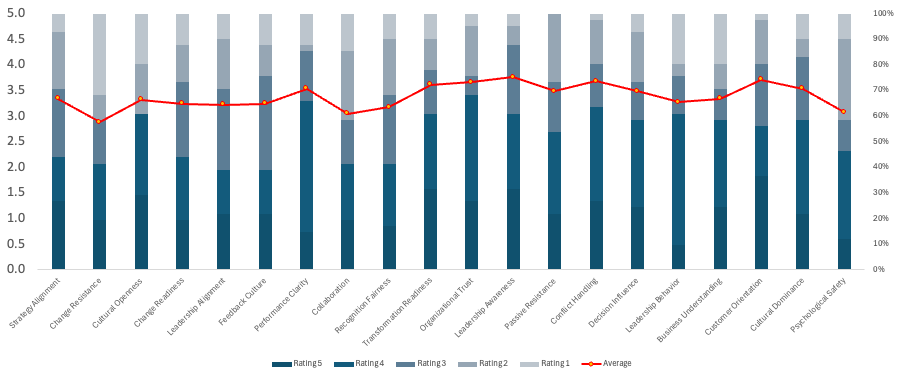
We ask the leadership team to describe the organisation's top three priorities for the year. Then we walk the floor and ask frontline supervisors, team leaders, and operators the same question not in those words, but in conversation.
In a healthy organisation, the answers rhyme. Not perfectly, but recognisably. The strategic direction has translated into operational understanding.
In a quiet factory, the answers are from different planets.
The MD talks about operational excellence and customer centricity. The line supervisor talks about meeting the daily number without getting shouted at. The quality inspector talks about surviving the month without a major rejection. The maintenance supervisor talks about getting spares approved before the breakdown happens, not after.
None of these people are wrong about their own experience. But none of them are running the same organisation. And until they are, no investment in technology, process, or systems will generate the return it should.
This is the real work of manufacturing excellence in 2026. Not the next ERP. Not the next certification. Not the next improvement programme.
The real work is closing the gap between the organisation that exists on paper and the one that exists in practice. Measuring it honestly and building the architecture in systems and in people to bridge it.
That work is unglamorous. It requires honesty that organisations are often not structurally set up to produce. It requires leaders who are genuinely more interested in what is true than in what is comfortable.
But it is the only work that produces manufacturing excellence that lasts. Everything else is decoration.


Comments