Manufacturing CEO’s Guide to AI Transformation: From Pilot to Performance
Why AI under-delivers, what to prepare, how to govern it, how to align people, and the step-by-step path to full AI and human integration

Executive summary - Manufacturing CEO’s Guide to AI Transformation
Every manufacturing CEO is now being told that AI will transform the business. Many have already spent money on it. Few can point to a clear, lasting change in cost, output, quality or cash.
The reason is rarely the technology. AI fails in manufacturing for the same reasons most improvement programmes fail: the plan is vague, the data is fragmented, nobody owns the deviations, root causes are guessed rather than proven, corrective actions are not followed through, and people quietly resist a change they do not understand.
ansoim has spent years helping manufacturers close the gap between plan and actual. Our method is simple to describe and hard to sustain: compare plan against actual, identify the deviations that matter, find their root causes, implement corrective and preventive actions (CAPA), and manage the change so the new way of working becomes culture. AI does not replace this discipline. It makes every step faster, wider and harder to ignore.
This white paper is written for the CEO. It covers five questions:
• Why do AI initiatives fail or under-deliver in manufacturing companies?
• What must the CEO prepare before investing further?
• What governance system keeps AI tied to business results?
• What people alignment is needed so that the workforce adopts AI rather than resists it?
• What is the step-by-step path to full integration of AI and human work across every function?
It draws on ansoim's own knowledge base, built from our diagnostic and transformation work with manufacturing and industrial companies, and on public evidence from the World Economic Forum, the OECD, the World Bank and UNIDO.
Manufacturing CEO’s Guide to AI Transformation.
Why is this the CEO's moment to act?
AI has moved from the laboratory to the shop floor. The World Economic Forum's Global Lighthouse Network, its community of the world's most advanced production sites, reports an average productivity gain of around 40%. The frontier group has scaled AI, automation and workforce transformation together.
Adoption is rising quickly. In OECD countries with available data, AI use among businesses with ten or more employees grew from around 7% to 20% between 2021 and 2025.
Yet the gap between using AI and benefiting from it is wide. The World Bank's Digital Progress and Trends Report 2025 finds that intentional AI adoption by firms remains limited, at 8% even in advanced economies, and lower still in developing countries.
For Indian manufacturers, this creates both risk and opportunity. The risk is that larger, data-rich competitors pull ahead. The opportunity is that most of the market is still at the starting line. A CEO who builds the right foundation now can move from pilot to performance while competitors are still experimenting.
The workforce question is just as urgent. The World Economic Forum's Future of Jobs Report 2025 expects 39% of workers' core skills to change by 2030. A plant that installs AI without preparing its people will find the technology underused within a year.
Why do CEOs fail to implement AI, and why does AI under-deliver?
In our diagnostic work, we see the same failure patterns repeat across sectors, from cement and metal to engineering, chemicals and consumer goods. None of them is a technology problem.
AI is bought as a tool, not tied to a business gap
The most common starting point is a vendor demonstration. A dashboard looks impressive, a pilot is approved, and only afterwards does someone ask which business problem it solves. If AI is not linked to a specific gap between plan and actual, such as lost output, high rejection, excess inventory or margin leakage, it has no way to prove its value.
The plan itself is weak
AI compares actual performance against a standard. If the annual operating plan is a top-down number with no breakdown by line, shift, product or customer, there is nothing meaningful to compare against. Many companies discover that their real problem is not a lack of AI but a lack of a credible plan.
Data is fragmented and nobody owns it
Production data sits in machine logs and spreadsheets. Quality data sits in a separate register. Maintenance history lives in a technician's notebook. Sales data sits in the ERP but uses different product codes. The World Bank names data, alongside connectivity, compute and skills, as one of four foundations any organisation needs to benefit from AI. Without a named owner for each data stream, AI produces inconsistent answers and loses credibility.
Deviations are reported but not owned
Many companies already have more reports than they can read. AI often adds another. The dashboard shows a problem, but no one is accountable for closing it. The same losses appear month after month.
Root cause analysis is skipped or done on opinion
When a deviation appears, the instinct is to fix the symptom. Output is down, so run overtime. Rejects are up, so add an inspector. AI can test many possible causes at once, but only if the organisation has the habit of asking why before acting.
CAPA is announced but not verified
Corrective actions are agreed in a meeting and then forgotten. Nobody checks whether the action was done, whether it worked, and whether the problem returned. This is where most improvement, with or without AI, quietly fails.
Skills are missing at the middle
The OECD reports that around 40% of manufacturing and finance employers that have not adopted AI say skills are the main reason. In our experience, the gap is sharpest among supervisors and middle managers. They are expected to act on AI insights but were never trained to read them or to run a structured problem-solving review.
8. People fear the transparency
AI makes performance visible. A shift supervisor who used to explain losses in the monthly meeting now sees them on a screen every morning, and so does his manager. OECD surveys show that 56% of manufacturing workers felt increased pressure to perform because of data collection, and 51% were worried about their privacy. Without careful change management, transparency produces defensiveness, not improvement.
9. The CEO delegates it to IT
When AI is treated as an IT project, it gets IT-style success measures: systems installed, users trained, go-live achieved. None of these measures shows up on the profit and loss statement. AI must be owned by the CEO and the operating leadership, with IT as a critical enabler.

What must the CEO prepare before investing further to AI Transformation?
Before approving the next AI budget, a CEO should be able to answer six questions with confidence. In ansoim engagements, we use these as a readiness checkpoint.
Is our plan credible and granular?
Every major target in the operating plan should be broken down to the level where someone can act on it: line, shift, product family, supplier, customer, region.
Do we know our biggest deviations in rupees?
The CEO should be able to name the top five gaps between plan and actual and their financial impact. These, not a vendor's list of use cases, define where AI should start.
Is our data good enough for these five gaps?
Not perfect, just good enough. That means a named owner, consistent definitions, and regular capture.
Do we have a problem-solving discipline?
If the organisation cannot run a structured root cause analysis without AI, it will not run one with AI.
Who will own the results?
Each priority deviation needs a business owner, not an IT owner, with authority to act.
Is the leadership team aligned?
If the head of production, the head of sales and the CFO describe the problem differently, AI will be blamed for the disagreement.
What the CEO must do personally to ensure sustainable AI Transformation
Some things cannot be delegated. The CEO must chair the Weekly review and ask about deviations and verified savings, not about system go-live dates.
The CEO must protect the people who surface bad news, especially in the first few months, when every new dashboard reveals uncomfortable truths. And the CEO must be visibly patient with the foundation stage, because pressure for quick wins is the most common reason companies skip it and later stall.
If the answer to any of these is no, that is where the work begins. This preparation is not a delay. It is the difference between a pilot that impresses and a transformation that pays.

The ansoim method: where does AI fit?
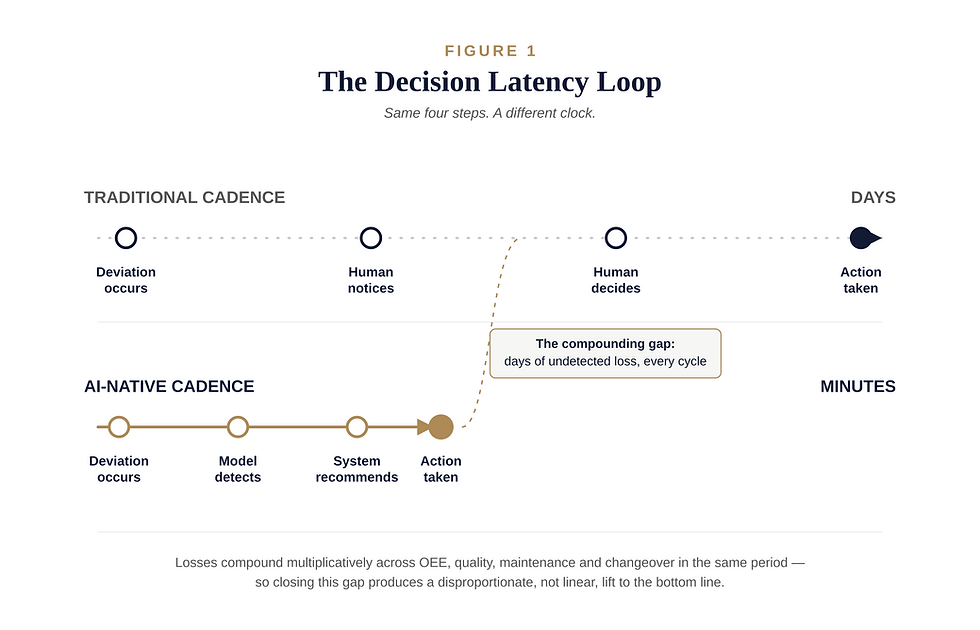
The ansoim method is a closed loop that turns operating data into lasting improvement. It has five steps. AI strengthens each one, but people remain responsible for decisions.
Plan versus actual.
AI brings data from ERP, machines, quality records, maintenance logs and sales systems into one view. It refreshes daily or by shift rather than at month-end, so gaps are visible while they are still small.
Identify the deviation.
AI separates normal variation from real shifts, ranks deviations by financial impact, and finds patterns a monthly report hides, such as one shift, one supplier, one customer or one product family.
Root cause analysis.
AI tests many possible causes at the same time and gives the team a short list of evidence-backed suspects. The team then confirms the cause on the floor using familiar tools such as the 5-Why and the fishbone diagram.
CAPA.
AI tracks whether each corrective and preventive action was completed and whether the deviation actually closed. If the problem returns, the system flags it automatically.
Change management.
AI makes performance visible to everyone. ansoim designs the routines, roles, incentives and communication that turn that visibility into ownership rather than fear.
The loop then repeats. Each cycle lifts the standard, and the plan for the next period is built on what the organisation has learned.
How does AI help each function?
The loop applies across the whole business, not only the plant. The table below summarises what it looks like in each function.
Function | Plan vs actual | Typical root cause AI helps surface | CAPA and the habit to build |
Production | Daily output, OEE, schedule adherence | Changeover overruns on specific shifts or SKUs | Standardised changeover; shift leads review losses daily |
Maintenance | Planned vs breakdown hours, MTBF | Lubrication or PM tasks skipped under output pressure | Condition-based PM; protect maintenance windows |
Quality | First-pass yield, rejects, complaints | Raw material batch or process drift | Supplier controls; stop-and-fix authority on the line |
Supply chain | Forecast accuracy, OTIF, inventory days | Forecast bias, supplier lead-time slippage | Consensus S&OP; supplier scorecards |
Sales | Volume, price, mix, collections | Discounting outside policy, mix shift to low-margin SKUs | Margin-based targets; deal review |
HR | Headcount, attrition, overtime, training hours | Attrition clustered under particular supervisors | Supervisor coaching; skill matrices |
Finance | Budget vs actual cost per unit | Hidden cost of the deviations above | Monthly cost-of-deviation review |
Manufacturing and production
The plan says 1,000 units a shift. The line delivers 870. AI breaks the gap into minor stoppages, slow running, changeovers and material waiting. If most of the loss sits in changeovers on two product families on the night shift, the supervisor has a cause he can act on the next morning.
Maintenance
Equipment usually gives warning before it fails. AI watches vibration, temperature and power draw and alerts the team early. The OECD notes that AI-powered predictive maintenance is reducing downtime and maintenance costs in manufacturing. The deeper value is in root cause. When repeat failures trace back to skipped preventive tasks in high-output weeks, the corrective action is a leadership decision to protect maintenance time.
Quality
AI links defects to the conditions that produced them: material batch, process setting, operator, time of day. Camera-based inspection can check every part rather than a sample. CAPA becomes specific and verifiable.
Supply chain
AI improves forecasts and, more importantly, exposes forecast bias. If the sales forecast is consistently optimistic, inventory and working capital suffer. AI also tracks supplier lead times and warns of slippage before it becomes a stock-out.
Sales
Revenue can meet target while margin misses. AI splits the gap into volume, price and mix and shows which customers, regions or salespeople drive it. A common root cause is discounting outside policy. The lasting fix is a change in how targets are set and rewarded.
Human resources
AI shows where attrition, absenteeism and overtime cluster. When attrition concentrates under a handful of supervisors, the cause is usually leadership behaviour, not pay. HR becomes a partner in operational performance.
Finance
Finance ties the loop together. AI attaches a rupee value to every deviation, so the CEO sees the true cost of poor quality, downtime and forecast error in one place, and the board sees a clear link between operational actions and financial results.
What governance system does AI need in Manufacturing Transformation?
Governance is what keeps AI tied to business results after the excitement of the pilot fades. ansoim recommends a light but firm structure with six elements.
1. A CEO-chaired transformation council
A monthly council of the CEO, CFO and functional heads. It approves priorities, reviews value delivered against value promised, and removes obstacles. AI is a standing agenda item in the operating review, not a separate technology meeting.
2. An internal transformation office
A small team, often two or three people, that maintains the register of deviations, root causes, CAPA and financial impact. It is the single source of truth for what AI has delivered. Every claimed saving is verified with finance.
3. Clear data ownership
Each critical data stream has a named business owner responsible for its accuracy, definitions and timeliness. IT provides the platform; the business owns the content.
4. Decision rights
The organisation decides in advance which decisions AI can make automatically, which it recommends for human approval, and which stay entirely with people. For example, AI might automatically re-sequence a maintenance schedule, recommend a change in a supplier allocation, and never decide a disciplinary matter.
5. Responsible use and risk controls
Simple, written rules on data privacy, worker monitoring, model accuracy and escalation. UNIDO has recently published, with partners, a governance framework for AI in industry. Companies do not need to copy it, but they should have their own clear rules before scaling.
6. Vendor and partner discipline
Technology partners should be held to business outcomes, not features. Contracts and reviews should ask what deviation the tool helps close and how that will be measured. Avoid locking critical plant data into a single proprietary system. Insist that the company owns its data, its definitions and its models, so it can change partners without starting again.
7. The review rhythm
Governance lives in routines. We recommend a daily review at the line, a weekly review at the plant, and a monthly review at the leadership table. Each meeting looks at the same plan-versus-actual data at a different level, and each ends with owners and dates.
What people alignment is required in Manufacturing CEO’s AI Transformation?
AI changes how people work, how they are measured and how they feel about their jobs. Alignment does not happen by announcement. It has to be designed.
Start with the purpose, not the tool
People accept change when they understand why. The CEO should explain, in plain language, which business problems AI is meant to solve and what it will not be used for. If AI is not intended to reduce headcount, say so clearly and early.
Move from blame to cause
The single most important cultural shift is in how leaders respond to bad news. When a deviation appears, the first question must be "what happened?" not "who did it?". Leaders who punish problems will find that problems stop being reported, and AI will be fed bad data.
Build skills at every level
The OECD finds that workers who receive training are more likely to report positive outcomes from AI, including better performance and better working conditions.
Training should match the role:
• Leaders need to read AI insights, ask good questions and run disciplined reviews.
• Supervisors and engineers need structured problem-solving skills and confidence with data.
• Operators and technicians need to understand what the system shows them and how to act on it.
Redesign roles, not just tasks
When AI takes over routine analysis, the planner's job shifts from compiling data to resolving exceptions. The quality inspector's job shifts from checking samples to improving the process. These new roles must be written down, trained and rewarded.
Align incentives
If supervisors are rewarded only for output, they will hide quality and maintenance problems. Incentives should reflect the balanced set of measures the AI system tracks.
Involve people early
The OECD reports that four in five manufacturing and finance workers who use AI say it improved their performance. That positive experience depends on involvement. Operators who help design how AI is used on their line become its strongest advocates.
What is the step-by-step path to full AI and human integration, Manufacturing CEO’s Guide to AI Transformation?
ansoim's roadmap has six stages. Each stage has a clear exit test. The organisation moves forward only when the test is met.
Stage 1: Diagnose (weeks 1 to 6)
Assess plan quality, data readiness, problem-solving maturity and leadership alignment. Quantify the top deviations in rupees.
Exit test: leadership agrees on the five priority deviations and their financial value.
Stage 2: Build the foundation (weeks 4 to 16)
Fix the plan where it is weak. Assign data owners. Clean and connect only the data needed for the priority deviations. Set up the transformation council and internal transformation office.
Exit test: a reliable daily plan-versus-actual view exists for the priority areas.
Stage 3: Prove the loop (weeks 12 to 24)
Run the full cycle of deviation, root cause, CAPA and verification on each priority. Use AI for detection and analysis; keep decisions with people.
Exit test: at least three deviations are closed and verified by finance, and they stay closed.
Stage 4: Embed the routines (weeks 24 to 52)
Install the daily, weekly and monthly reviews. Train supervisors and leaders. Redesign roles and adjust incentives.
Exit test: reviews run without the consultant in the room, and new deviations are raised by the team, not by management.
Stage 5: Scale across functions (weeks 24 to 18)
Extend the loop from production to maintenance, quality, supply chain, sales, HR and finance, in order of financial value. Reuse what worked; do not restart each function from scratch.
Exit test: every function has an owned set of AI-supported plan-versus-actual measures in the monthly review.
Stage 6: Integrate AI and human work (weeks 32 onwards)
At this stage AI is part of how the company runs. Routine decisions within agreed limits are automated. People focus on exceptions, improvement and customers. The annual plan is built on what the loop has learned.
Exit test: the organisation improves its own standard every year, without external push.
The timelines are indicative.
A focused mid-sized manufacturer can reach Stage 4 within nine months. The pace is set by the organisation's ability to change, not by the software.
What does the journey look like in practice?
The following example is illustrative. It is a composite drawn from patterns in ansoim's knowledge base, not the record of a single client.
A mid-sized engineering components manufacturer had invested in a production monitoring system two years earlier. The dashboards worked, but output was still about 12% below plan, and customer complaints were rising.
Diagnosis. The plan-versus-actual review showed that the annual plan was set at plant level only. Nobody could say which lines or products were behind. When the plan was broken down, three product families on two lines accounted for most of the gap. Rejections on one critical machining operation were the second-largest loss.
Root cause. The analysis pointed to two suspects: changeovers on the night shift that took twice as long as on the day shift, and rejection spikes that followed deliveries from one raw material supplier. Floor investigation confirmed both. Night-shift setters had never been trained on the revised changeover standard, and the supplier had changed its heat-treatment process without notice.
CAPA. The company trained and certified night-shift setters, added a changeover checklist, and introduced incoming checks and a corrective action request with the supplier. The value office tracked each action, and AI monitored whether the deviations returned.
Change management. The bigger shift was cultural. Supervisors initially saw the daily review as a blame session. The plant head changed the opening question to "what did we learn yesterday?" and began recognising teams that raised problems early. Within a few months, operators were raising deviations before the dashboard did.
Scale. With production stable, the same loop was extended to maintenance planning, then to sales forecasting, where AI exposed a consistent optimism bias that had been inflating inventory.
The lesson is consistent across our work. The technology found the problems. The method and the culture fixed them.
How does ansoim support the CEO through this journey?
ansoim works alongside the CEO and leadership team from diagnosis to integration. Our role changes as the organisation matures.
• In diagnosis, we bring structured assessment tools that quantify deviations and readiness, so priorities are based on evidence rather than opinion.
• In the foundation and proof stages, we work on the floor with plant and functional teams, running root cause analysis and CAPA alongside them until the method is familiar.
• In embedding and scaling, we design governance, train leaders and supervisors, and coach the review routines until they run on their own.
• Throughout, we keep the focus on financial results. ansoim works on an ROI-committed basis, so the measure of success is agreed at the start and tracked to the end.
We are technology-neutral. We help clients choose and use tools that fit their needs, but our accountability is for the business outcome, not the software.
Frequently asked questions
Do we need a large technology budget to start?
No. Most mid-sized manufacturers can begin with data already in their ERP, spreadsheets and machine logs. The discipline of the loop matters more than the size of the system.
Will AI replace our managers and engineers?
No. AI narrows down where to look and why. People still decide what to do and make it happen. The World Bank argues that, for developing economies, the greatest promise of AI lies in amplifying what workers can do rather than replacing them.
How long before we see results?
In a focused programme, the first verified savings typically appear within the proof stage, three to six months after starting.
How is this different from a software implementation?
A software project ends at go-live. Our engagement ends when deviations close and stay closed, and when the organisation runs the loop without us.
Conclusion
AI gives manufacturing CEOs something they have always wanted: an early, honest view of where the business is drifting from plan, and why. But insight is only the beginning. Value comes when every deviation has an owner, every root cause is proven, every corrective action is checked until the gap closes, and every person understands their part.
That is a management system and a culture, supported by AI. CEOs who build it will not just adopt AI. They will become organisations that learn faster than their competitors. That is the journey ansoim helps its clients complete. Manufacturing CEO’s Guide to AI Transformation.
World Economic Forum, “Takeaways from the world’s largest dataset on industrial transformation,” 29 October 2025. https://www.weforum.org/stories/emerging-technologies/takeaways-from-the-world-largest-dataset-industrial-transformation/
World Economic Forum, Future of Jobs Report 2025, Chapter 3: Skills outlook, January 2025. https://www.weforum.org/reports/the-future-of-jobs-report-2025/in-full/3-skills-outlook/
OECD (2026), “Skills in the AI age”, OECD Artificial Intelligence Papers, No. 60, OECD Publishing, Paris, https://doi.org/10.1787/972bd15e-en
OECD (2026), “AI and skills: What we know so far”, OECD Publishing, Paris, https://doi.org/10.1787/f843b352-en
OECD, AI and Work (topic page summarising OECD employer and worker surveys in manufacturing and finance). https://www.oecd.org/en/topics/sub-issues/ai-and-work.html
World Bank, Digital Progress and Trends Report 2025: Strengthening AI Foundations. https://www.worldbank.org/en/publication/dptr2025-ai-foundations
World Bank, World Development Report 2026: The Promise of Artificial Intelligence, press release, 4 August 2026. https://www.worldbank.org/en/news/press-release/2026/08/04/ai-offers-lifeline-to-developing-economies-in-an-era-of-weak-growth
UNIDO, “UNIDO advances global cooperation on AI for industry at WAIC 2026,” 23 July 2026 (UNIDO news release, republished on eTrade for all). https://etradeforall.org/es/node/15297


Comments