Decision Latency: The New Manufacturing Advantage With AI
Why the plants pulling ahead in the AI era are not the most automated — they are the fastest to close the gap between a signal and a decision.
Every lever manufacturing has pulled for a century to gain advantage; cheaper labour, larger scale, newer capital — is now available to your slowest competitor on roughly the terms you paid for it.
Automation is a catalogue item. Capital is available to anyone with a rating above BBB. What still compounds, and what still separates the operator who wins a decade from the one who merely survives it, is something that never shows up on a balance sheet: how fast the organisation converts a signal on the floor into the correct decision.
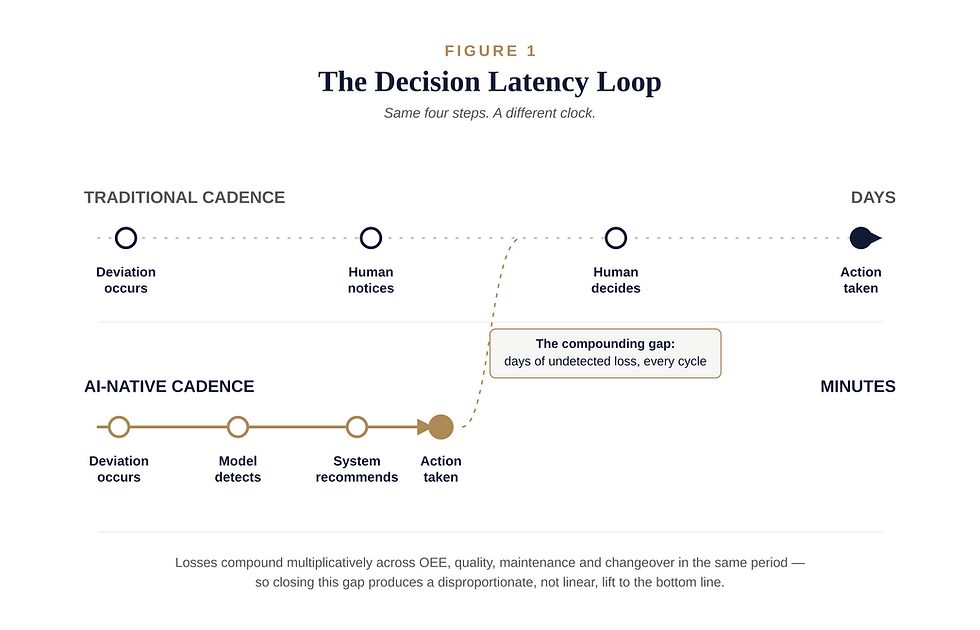
Call it decision latency — the interval between a deviation occurring and the moment a person or system does the right thing about it. AI does not change what manufacturing excellence means. It collapses decision latency toward zero, and because losses compound multiplicatively across OEE, quality, maintenance and changeover in the same period, a modest reduction in latency at every layer produces a disproportionate lift at the bottom line — the kind that used to require a new line, not a new dashboard.
For most of industrial history, that interval was measured in shifts, days, sometimes quarters, because information had to travel through people before it could travel through wire. The table below is what changes when it no longer has to.
Discipline | Traditional cadence | AI-native cadence |
OEE | Reviewed monthly / weekly, reconstructed from perceptions | Continuously computed, loss-attributed in real time |
Quality | Sampled — one unit in N inspected | Every unit inspected; drift corrected before the defect occurs |
Maintenance | Calendar-based, generic interval | Condition-based, asset-specific, days-to-failure estimate |
TPM | Weekly audit, paper checklist | Continuous anomaly detection, operator-triggered in real time |
Lean | Value stream mapped once a year, on a wall | Value stream computed continuously from transaction data |
SIC | Hourly board, manually transcribed | Sub-minute variance detection, auto-populated |
Daily Management | Escalation dependent on memory | Escalation triggered algorithmically; cross-shift continuity preserved |
WHY THIS IS A CAPITAL ALLOCATION QUESTION, NOT AN IT QUESTION
A plant that lifts OEE from 68% to 78% has, in effect, built roughly 15% more capacity without pouring a slab of concrete or filing a capex request. Run that arithmetic against your last three expansion business cases and the comparison gets uncomfortable fast: most brownfield or greenfield capacity additions carry payback measured in years and execution risk measured in quarters of delay. A ten-point OEE improvement, financed correctly, typically pays back within a single fiscal year.
The reason most boards don't run this comparison explicitly is organisational, not technical — OEE has historically lived in an operations review, three levels below where capital gets allocated. That is a design flaw in how the business reviews itself, and it is entirely within a CEO's authority to fix, starting with the next capital committee agenda.
THE REAL ASSET ISN'T THE ALGORITHM. IT'S THE DATA
Every vendor in this space will sell you a model. None of them can sell you your own five years of stoppage history, your own failure signatures, your own defect-to-parameter correlations because that data doesn't exist anywhere else. It is specific to your assets, your operators, your raw-material variability, your climate.
This is the quiet strategic fact that CEOs already price into the software platforms and have not yet fully priced into manufacturing: the algorithms are converging toward commodity. Most vendors now license comparable foundation models for vision and time-series forecasting, while proprietary operating data is the one input that cannot be purchased, replicated, or poached by a competitor hiring away your head of reliability.
A plant that has captured clean, structured shopfloor data for five years has a five-year head start that no capital cheque closes. Treat that data as a balance-sheet asset with a named owner — not as exhaust that IT happens to be storing.

FROM PREDICTIVE TO AGENTIC: THE GOVERNANCE QUESTION ARRIVING AT YOUR BOARD
The AI most plants have deployed to date is predictive — it tells a human what is likely to happen and lets the human decide. The next wave, already live in a handful of process industries, is agentic: the system doesn't just recommend a setpoint change, it makes it, inside defined guardrails, without waiting for a shift supervisor to close a ticket.
This is a materially different risk profile, and it raises a question no plant manager can answer alone: where exactly is the boundary between AI that recommends and AI that acts?
Who is accountable when an autonomous adjustment to a process parameter turns out to be wrong — the vendor, the plant, the model, or the executive who approved the deployment?
Boards in regulated sectors — pharmaceuticals, aerospace, automotive — are going to ask this question whether or not the plant is ready to answer it. Defining the autonomy boundary before a regulator, an insurer, or an incident defines it for you is now a board-level governance decision, not an engineering one.

EIGHT SYSTEMS, ONE LOOP
Each classical discipline changes for a different, specific reason — not a generic one. The strategic implication, in each case, is sharper than "AI makes it faster."
OEE
The truest P&L in the plant is moving out of the monthly ops review and into the same forecasting discipline used for demand and pricing, because a validated OEE trend is now a leading indicator of standard cost, not a lagging one.
Quality
The real argument for full-population inspection isn't scrap cost. It's the negotiating position a supplier holds the moment a warranty dispute opens: sampling data settles arguments statistically, weeks later; unit-level data settles them immediately.
Maintenance
Predictive maintenance's real payoff isn't avoided breakdowns. It's the insurance renegotiation and the spares-inventory reduction that follow once an underwriter or a CFO trusts the failure model enough to stop pricing for the worst case.
TPM
TPM was built to catch small abnormalities using the one sensor no vendor sells: an engaged operator. AI extends that sensor's range and memory — it cannot manufacture the engagement. Plants buying the technology to compensate for a disengaged workforce are buying a more expensive way to notice the same failures later.
Lean
Lean's oldest complaint about itself was that value-stream maps went stale the week after the workshop. That complaint is now obsolete. What isn't obsolete is the discipline to act on what a live map shows — an organisation that watches waste accumulate in real time without changing behaviour has simply built better instrumentation for its own dysfunction.
SIC
Short Interval Control was designed to be the fastest correction loop on the floor and became, in most plants, a compliance ritual. AI restores the original design intent — variance is caught inside the hour it occurs, not the next shift's huddle.
Daily Management
The tiered escalation cascade's real vulnerability was never the meeting. It was the two hours before it, when a night-shift observation quietly evaporated. Algorithmic escalation closes that specific gap — which matters most exactly where human attention is scarcest, across shifts and across sites, at two in the morning.
Digital Manufacturing
Every claim above depends on one unglamorous precondition: a historian and a tag-naming convention someone actually maintains. This is where the majority of AI-in-manufacturing capital quietly evaporates, and the single most common reason a pilot that worked on one line never scales to twelve.
WHAT THIS REQUIRES OF THE CEO, SPECIFICALLY
1. Reclassify OEE, and its equivalents, as capital-allocation inputs reviewed alongside capex requests — not metrics buried three levels down in an operations review.
2. Assert explicit ownership of operating data in every vendor and system-integrator contract, before signing, not after a dispute over who can access five years of your own stoppage history.
3. Set the autonomy boundary for agentic deployments personally, in writing, before a regulator, insurer, or incident sets it for you.
4. Fund the boring layer of historian, tagging convention, MES/ERP integration as a multi-year capital commitment, not a line item inside a vendor's statement of work.
THE BOTTOM LINE
None of this is about replacing plant managers with algorithms, and any vendor telling you otherwise is selling something else. It is about recognising that in a world where the equipment, the capital, and increasingly the algorithms themselves are available to every competitor on comparable terms, the only advantage left that compounds is speed of correct decision.
That advantage now belongs to whichever leadership team decided, deliberately, to go after it first — which is exactly where ansoim's diagnostic work, PACA and OMEA, starts: testing whether the human and process fundamentals underneath a plant's ambitions can actually carry the weight of the decision-latency advantage it is trying to build.
FREQUENTLY ASKED QUESTIONS
What is decision latency, and why does it matter more than automation?
Decision latency is the interval between a deviation occurring on the floor and the correct action being taken. Automation changes what a machine can do; decision latency changes how fast the organisation notices and corrects a problem. Because losses compound across OEE, quality and maintenance simultaneously, cutting latency at every layer produces a disproportionate, not linear, improvement in output.
Is an AI-driven OEE improvement really comparable to a capacity expansion?
Directionally, yes. A sustained OEE gain increases effective output from existing assets without new capital investment, and typically pays back within a fiscal year, materially faster than most brownfield or greenfield expansion business cases.
What is the difference between predictive and agentic AI on the shop floor?
Predictive AI recommends an action and waits for a human to approve it. Agentic AI executes the action itself, inside defined guardrails, without waiting for approval. The shift from one to the other changes the risk and accountability profile enough that it warrants an explicit board-level decision on where the autonomy boundary sits.
Who should own the data an AI vendor's model is trained on?
The operating company, by explicit contractual right, not the vendor by default. Proprietary shopfloor data — failure signatures, defect correlations, stoppage history is increasingly the more durable competitive asset, since the underlying algorithms are converging toward commodity across vendors.
What is the single biggest reason plants fail to scale AI beyond a pilot?
People misalignment, an unstructured data foundation. Connectivity, historian coverage and consistent tagging are unglamorous, multi-year investments; skipping them is why a pilot that works on one line typically does not scale to twelve.

Comments