Why Manufacturing Projects Delay
A greenfield, brownfield, and heavy engineering diagnostic for CEOs and MDs
A. Self Diagnostic for PMO
Answer these honestly about the project currently on your desk. None of them require a project management background. They require candor.
Do scope, schedule, cost, and ownership live in one place that the whole steering committee can see, or does each function keep its own version?
Do you know, without asking anyone, what the single most schedule critical item in this project is right now?
Has any commitment in this plan, a design freeze, a shutdown window, a delivery date, been agreed by the accountable stakeholder in writing, or only communicated to them?
When was the last time this project's schedule was challenged in a steering committee, rather than simply reported?
If this project is 3 months late a year from now, which decision made in the next 30 days will most likely be the reason?
If the last question is hard to answer, that is the finding. It means the project's real risk has not been named yet, which means nobody is managing it.
B. If the Diagnostic Made You Uneasy
If more than one was hard to answer cleanly, that discomfort is data. It usually means the project on your desk has the same structural gap described throughout this paper, scope, schedule, cost, and ownership sitting in different places instead of one, and a review cadence that receives updates rather than challenging them.
That gap is rarely visible from inside the project. The people closest to a schedule are the ones most invested in believing it will hold.
The best time to have this conversation is before the groundbreaking date is announced, not after it has already moved once.

Almost every delayed manufacturing project has the same origin story. Somewhere around month 14, a steering committee is told the go live date has slipped by 3 months. The reasons offered sound technical. A vendor was late. A permit took longer than expected. The site had unexpected soil conditions. Each explanation is true, and each one is also a cover story.
For the CEO in the room, the technical explanation is rarely the part that keeps them up at night. What keeps them up is the capital already committed with no revenue yet to show for it, the number they gave the board or the bank 6 months ago that now has to be walked back, and the quiet question of whether the market window the business case was built on is still open. A 3 month slip on a manufacturing project is rarely just 3 months of extra cost. It is 3 months of interest accruing on an asset that is not producing, 3 months of a competitor's product reaching a shelf yours was supposed to reach first, and 3 months of distance between what leadership promised and what leadership delivered.
The real decision that caused the delay was usually made in the first 90 days, not discovered in month 14. It was a scope left open for too long, a continuity plan that was estimated instead of negotiated, or an engineering package that was called complete when it was not. By the time the delay is visible on a dashboard, it has already been baked into the project for a year, and the financial exposure has been building quietly the entire time.
The dashboard tells you the project is late. It rarely tells you when the delay actually happened.
This paper is a diagnostic, not a project management framework. It is written for CEOs and MDs who want to know, before the next capex cycle begins, where the real financial and reputational exposure is likely to build up quietly, long before it shows up as a red status on a report.
Three Project Types, Defined by Where They Fail & Why Manufacturing Projects Delay
Greenfield, brownfield, and heavy engineering projects are usually taught as different in scale or setting. That is true but not useful. What actually separates them is where they characteristically fail, and what that failure costs the person accountable for the capital.
Greenfield projects delay from indecision on a blank canvas. Freedom to design anything becomes the reason nothing gets frozen in time.
Brownfield projects delay from underestimating a live operation. The project team plans the build. Nobody plans the interruption to production with the same rigor.
Heavy engineering projects delay from being run on a short cycle mindset inside a long cycle, debt financed reality.
Each of these failure modes has a distinct root cause, a distinct cost to the CEO, and a distinct point where leadership, not the project manager, needs to step in personally. The rest of this paper works through each one.
Why Do Greenfield Projects Delay?
A greenfield site offers something brownfield and heavy engineering projects rarely get, which is a completely open design space. That freedom is the appeal and, almost always, the trap.
What actually causes the delay
Scope stays open long after it should have closed, because every stakeholder wants one more input into a design that has no existing constraint to argue against.
Lack of End-to-End visibility, resulting into guess work and subjective decision making.
Lack of Short Interval Control over WBS.
Lack of Predictive Analytics, impacting future stage predictions.
Land and regulatory approvals get treated as a background workstream running in parallel, when in practice they sit on the critical path.
Vendor selection gets rushed at the end to protect a groundbreaking date that was announced before the design was frozen.
No formal design freeze date is set and enforced, so change requests keep entering the plan long after commitments were already made to the board.
Long lead civil and structural packages get ordered against a design that is still moving, which forces rework once the design finally settles.
What it costs the CEO
A greenfield project is capital committed before a single unit of product exists. Every month of delay is a month of interest cost, land holding cost, and executive time spent defending a start date that keeps moving, all before the plant earns a rupee of revenue.
The business case that justified the investment was built around a market window. If a competitor's capacity comes online first, the share the plant was built to capture may already be gone by the time it opens.
The question that would have caught it early
Has design been formally frozen, with a named owner and a date, or is it still open because nobody wants to be the one who closes it? If the honest answer is that design is still evolving 6 months after the groundbreaking date was announced, the project is already delayed. It has simply not been reported yet.
What the MD should own personally
The MD should personally close scope and freeze design before the groundbreaking date is set, not after. Announcing a start date before design is frozen converts a design decision into a public commitment that nobody then wants to revisit, even when revisiting it is exactly what the project needs.

Why Do Brownfield Projects Delay?
Brownfield projects are harder than greenfield projects in one specific way. The site is not empty. It is producing revenue, employing people, and running on a rhythm that predates the project by years.
What actually causes the delay
Production continuity is priced as an estimate rather than negotiated as a binding commitment with the operations team.
The tie in or shutdown window is set by the project team and only communicated to operations afterward, instead of agreed with them upfront.
Workforce and shift dynamics get treated as a human resources matter, separate from the project plan, when a live workforce navigating disruption is a core project risk.
Contingency time for unplanned production interruption is left out of the schedule entirely, so the first surprise consumes the whole buffer.
Tie in dates are planned with optimism because nobody wants to be the person who tells the plant head the shutdown window needs to be longer.
Lack of End-to-End visibility, resulting into guess work and subjective decision making.
Lack of Short Interval Control over WBS.
Lack of Predictive Analytics, impacting future stage predictions.
What it costs the CEO
Unlike greenfield, brownfield delay shows up immediately on the profit and loss statement, because the plant being modified is also the plant paying today's bills. Every day of unplanned downtime is lost production that sales has already promised to a customer, and in many supply contracts a shortfall triggers a penalty clause that turns a project delay into a customer relationship problem.
There is a quieter cost too. A shop floor that watches leadership underestimate the disruption to its own daily work loses some of the trust that the next change initiative will depend on.
The question that would have caught it early
Was the shutdown or tie in window agreed jointly with the operations head as a binding commitment, or was it set by the project team and simply communicated to operations afterward?
If operations was informed rather than involved, the schedule is optimistic by definition, and the gap will surface exactly when the disruption begins, which is the worst possible time to discover it.
What the MD should own personally
The MD should personally chair the plant continuity review, not delegate it to the project manager. Only someone with authority over both the plant head and the project can force an honest conversation about how much disruption the operation can actually absorb, and get both sides to commit to the same number.

Why Do Heavy Engineering Projects Delay?
Heavy engineering projects, process plants, large fabrication, capital intensive infrastructure, run on cycles measured in years, not months. Their most common failure is being managed with the urgency and reporting cadence of a much shorter project.
What actually causes the delay
Lack of End-to-End visibility, resulting into guess work and subjective decision making.
Lack of Short Interval Control over WBS.
Lack of Predictive Analytics, impacting future stage predictions.
Front end engineering gets compressed so the project can show visible progress early, which leaves detailed design under baked.
Long lead equipment, the items with 12 or 18 month manufacturing cycles, gets ordered late because procurement is sequenced after engineering sign off rather than run in parallel with it.
Interface management between multiple engineering contractors is left informal, so gaps between packages surface only when 2 contractors expect the other to have already finished something.
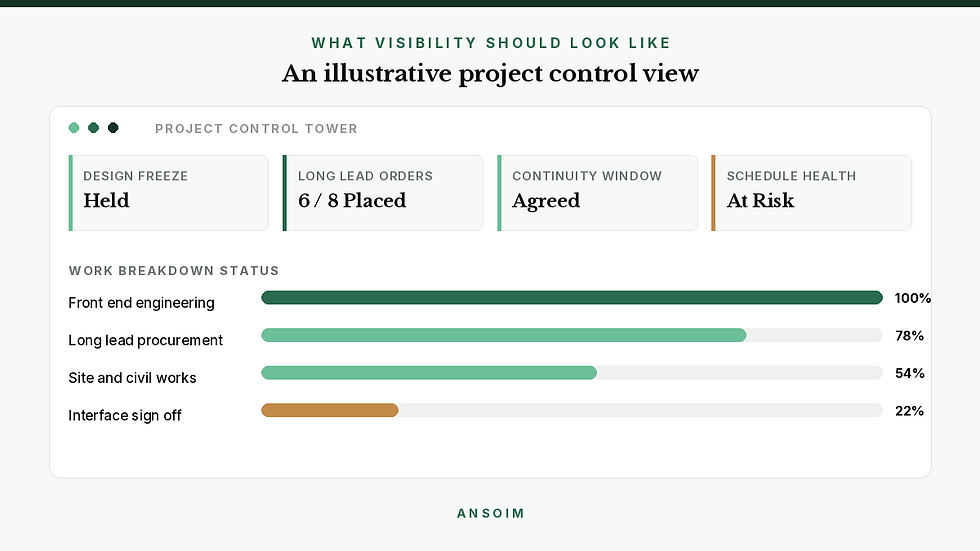
Engineering completion is reported as a percentage without reference to whether the deliverables actually on the critical path are done.
Financing milestones and drawdown schedules are not tied to actual construction progress, which masks the real state of completion until a lender asks.
What it costs the CEO
Heavy engineering projects carry the largest capital outlay of the 3, often financed with debt that starts accruing interest the day it is drawn, regardless of whether the asset is producing.
A delay here does not just push the completion date. It pushes the date the asset starts generating cash to service that debt, which can trip covenants with lenders and force conversations that have nothing to do with engineering and everything to do with financing terms negotiated years earlier.
The question that would have caught it early
Has procurement of the critical long lead items actually started, or is engineering still being reported as substantially complete while purchase orders for the equipment with the longest manufacturing cycle have not been issued?
A project can look green on every dashboard metric while the single most schedule critical item in the entire plan has not left the drawing board.
What the MD should own personally
The MD should personally review the long lead procurement list before approving the execution budget, and ask, item by item, whether the order has actually been placed. This is a 20 minute review that catches the most expensive category of delay in heavy engineering projects, and almost no MD does it, because it looks like a task for procurement, not for the top of the house.

The Common Thread Across All 3 Project Types
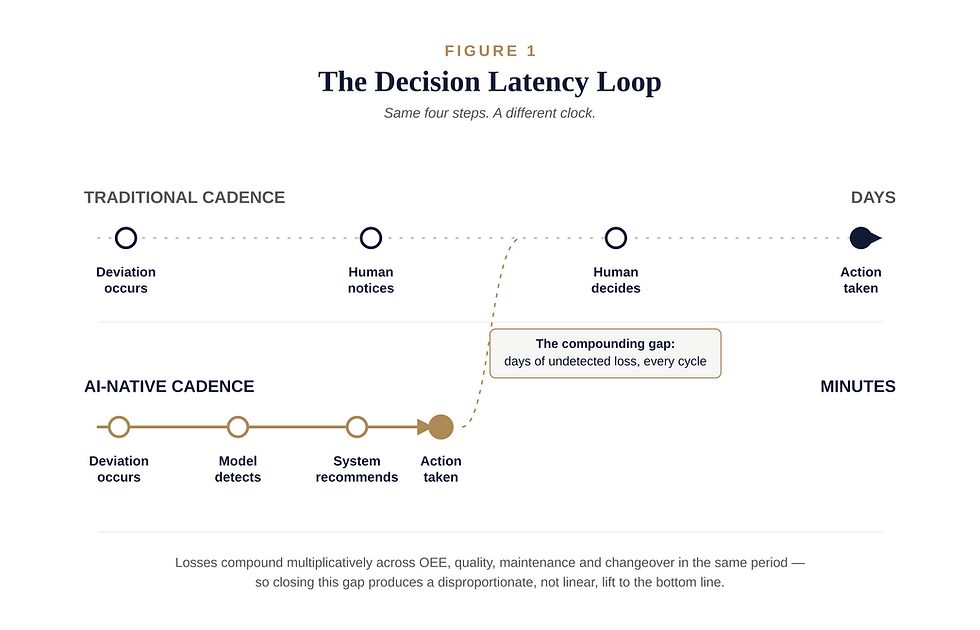
Strip away the technical language in any post mortem of a delayed manufacturing project and a pattern repeats. The delay was rarely caused by a technical failure. It was caused by decision latency, unclear ownership, or an early estimate that was optimistic and never revisited.
The project team did not cause the delay. The governance structure allowed it.
In every case, the technical narrative hides the same structural gap. Nobody was tracking scope, schedule, cost, and ownership as one connected structure.
Design kept its own tracker, procurement kept its own list, the site team kept its own log of what had actually been installed, and each version was internally consistent while disagreeing quietly with the others.
The gap between those versions is where the delay actually lived, and it is almost never visible until someone finally reconciles them, usually the same week the steering committee asks why the date moved.

The Structural Fix Most Project Management Offices Skip
The interventions described previously, freezing design earlier, negotiating continuity windows, ordering long lead items on time, are decisions.
Decisions need something to sit on.
Organizations that consistently avoid the delay pattern described above tend to share a small set of structural habits that have little to do with the technical complexity of the project and everything to do with how the project is structured and watched.
Build one work breakdown structure that ties scope, schedule, cost, and a named owner to every deliverable, and retire the parallel trackers that design, procurement, and the site team each tend to keep on their own.
Effectively Implement an easy to use Project Management Software
Treat that single WBS as the source of truth every function reports into, not a document that gets reconciled once a month after the fact.
Track leading indicators alongside the usual lagging ones, whether a long lead order has actually been placed, whether a design freeze date has been honored, whether a continuity window has been formally agreed.
Stop treating percentage complete as a health metric on its own. It reflects decisions already made and says nothing about the decisions still open.
Set a review cadence frequent enough to catch a slipping decision while it is still cheap to correct, rather than monthly enough that 1 month of drift has already hardened into fact.
Make review a genuine challenge, not a status update. Someone in the room should be expected to ask why a milestone moved and expect an answer beyond a vendor's excuse.
Assign one accountable owner per deliverable in the WBS, so a delay can be traced to a person and a decision, not to a phase or a function in the abstract.
Connect schedule, cost, and risk in a single integrated view, so a change in one is visible in the others immediately, rather than surfacing weeks later when someone finally reconciles 3 separate spreadsheets.
None of these habits require exotic tools. They require the discipline to build one structure instead of several, to report what is coming instead of only what has passed, and to make review a genuine challenge rather than a courtesy.
Most organizations already own software capable of doing this. What they are usually missing is the decision to treat one structure as the single source of truth, and the will to make review uncomfortable enough to be useful.
What Should CEOs and MDs Do Differently?
Everything below could be filed under project management practice. That undersells the problem. What actually sits underneath most of the delay described in this paper is not a scheduling failure, it is an information failure.
The person standing closest to a slipping decision usually has the most accurate picture of the risk in front of them, and the least incentive to say so, because raising it early reads as failure while staying quiet reads, for a while, as competence.
A CEO asking for an honest early warning is asking someone to send bad news up through a reporting structure that was built, structurally, to reward good news. That mismatch, not a shortage of talent anywhere in the organization, is the actual mechanism.
The information a CEO needs earliest is the information the organization is least incentivised to send up.
This reframes the task. It is not to read reports more carefully. It is to change what gets rewarded when someone tells the truth early, at the specific points in each project type where the incentive to stay quiet is strongest.
FOR GREENFIELD PROJECTS, WHERE THE BIAS IS OPTIMISM ABOUT FREEDOM
An open design space rewards whoever keeps options alive the longest, which is exactly the behavior that quietly erodes a schedule.
Set the design freeze date before you set the groundbreaking date, never the other way around.
Require a single WBS to be live before the first vendor is engaged, not assembled retroactively once the schedule starts slipping.
FOR BROWNFIELD PROJECTS, WHERE THE BIAS IS DEFERENCE TO THE PLANT
Operations has more to lose from being blamed for downtime than the project team has from a quietly optimistic tie in date, so caution flows in one direction only.
Require operations to co sign the continuity plan as a named commitment, not a briefing they received.
Move to weekly tie in readiness reporting in the final 60 days before shutdown, not the monthly cadence used for the rest of the project.
FOR HEAVY ENGINEERING PROJECTS, WHERE THE BIAS IS A NUMBER THAT LOOKS MEASURABLE
Once percentage complete becomes the target everyone is managed against, it quietly stops being an honest measure of progress.
Review the long lead procurement list personally before releasing the execution budget.
Require one master schedule that every contractor reports into, rather than accepting each contractor's own version as good enough.
Across all 3, the underlying move is the same, and it has nothing to do with risk aversion.
Saying no to an optimistic schedule is not caution.
It is the only rational response once you accept that early estimates are structurally biased toward optimism, and that the people reporting them have more to lose from sounding pessimistic now than from being wrong later, quietly, alongside everyone else.
Time volunteered generously today is very rarely repaid. It is borrowed from a phase further down the plan that has not yet been scrutinized closely enough to reveal the debt.


Comments